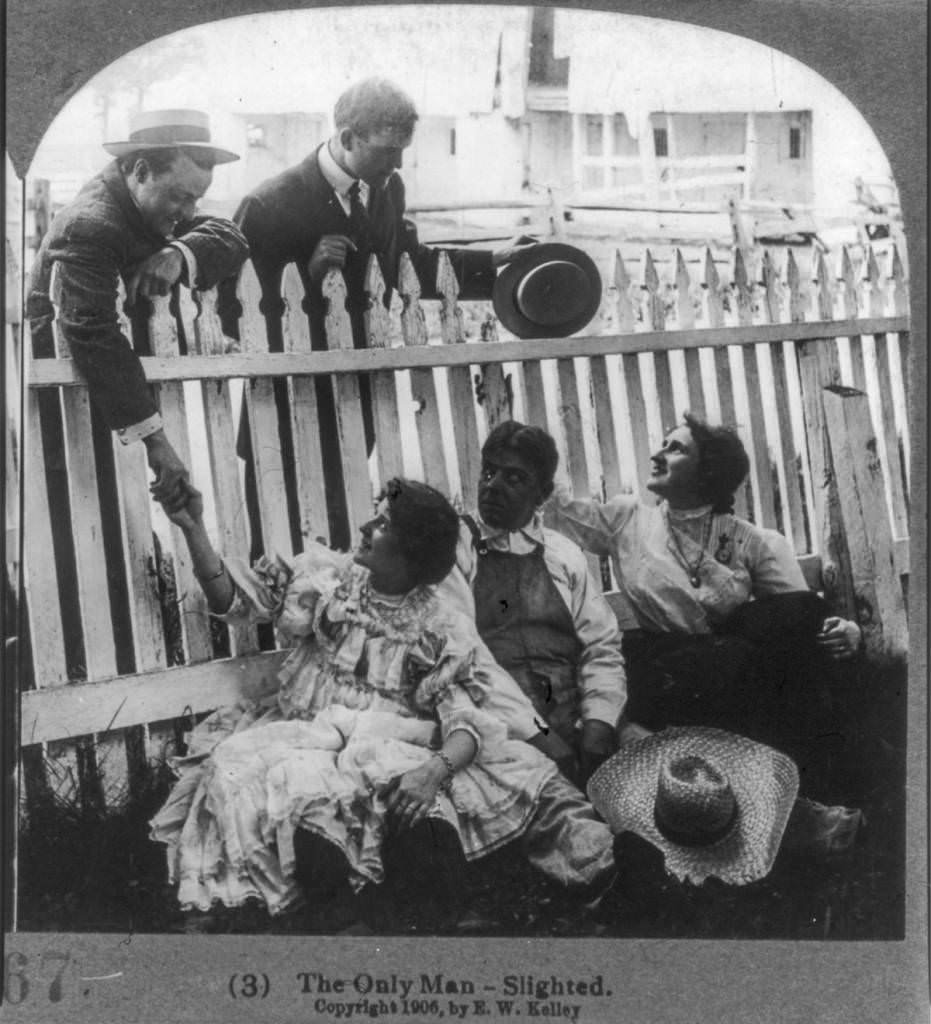
A cheeky little drama unfolds beside a tall white picket fence: one well-dressed man leans over the slats to clasp a woman’s hand, while another gentleman stands close by, hat in hand, watching the exchange. Below them, three figures sit on the grass in a loose cluster—two women in light dresses and a man in work clothes—forming a staged scene that feels half courtship, half punchline. The title, “The Only Man – Slighted,” hints at the joke before you even study the faces.
Costume details do much of the storytelling here, contrasting leisure and labor with a quick glance: tailored jackets and boater-style hats above, an apron and rolled-up sleeves below. The seated man’s expression reads as the center of the gag—caught between the women’s attention and the gallant greeting occurring overhead, he seems left out of the moment that matters. Even the fence becomes a prop, separating social spaces while letting flirtation slip through the gaps.
As an example of early 1900s humor photography, this 1906 image plays on everyday social rituals—introductions, favors, and the sting of being overlooked—using exaggerated posing to make the point instantly readable. The suburban backdrop and simple yard setting keep the focus on gesture and reaction, the building blocks of silent-era visual comedy. For anyone interested in antique photo postcards, Edwardian fashion, or the history of staged comedic scenes, “The Only Man – Slighted” offers a crisp, memorable snapshot of how a laugh was constructed more than a century ago.