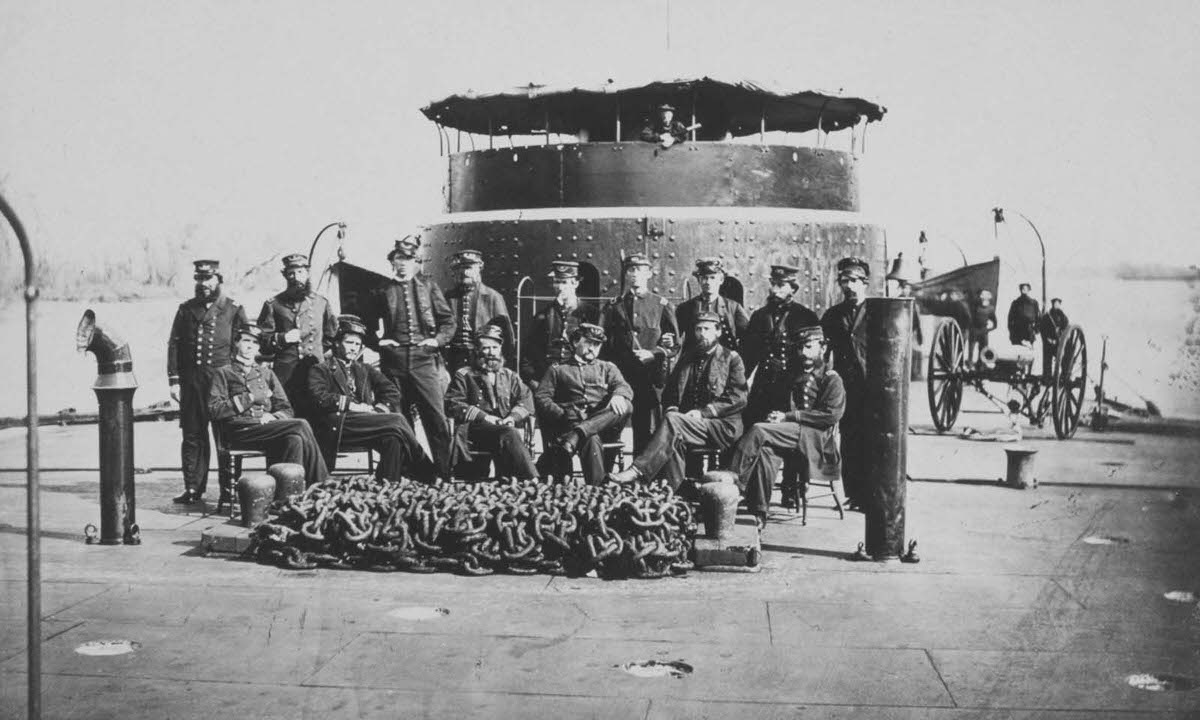
A cluster of Union naval officers pose with practiced stillness on the low, armored deck of a Monitor-class warship in 1863, their dark uniforms and caps set against the hard geometry of iron plating. Behind them rises the ship’s turret, its riveted sides and shaded top giving the scene a distinctly industrial silhouette—less like a traditional sailing vessel and more like a floating machine built for modern war.
Details on deck hint at the routine reality of Civil War naval service: heavy chain piled in the foreground, stout fittings and vents punctuating the flat surface, and equipment arranged with a working ship’s pragmatism rather than parade-ground neatness. Off to the side, a wheeled gun or carriage appears on the dock or nearby platform, underscoring how these ironclads operated within a wider landscape of coastal defense, river operations, and supply lines.
Monitor-class ironclads became icons of the American Civil War because they represented a turning point in naval warfare, where armor, steam power, and rotating gun turrets challenged older assumptions of speed and broadside fire. For readers searching Civil War history, Union Navy photographs, or the story of ironclad ships, this image offers a human-scale look at the men who served atop a new kind of warship—calmly assembled on metal that was designed to endure shot, shell, and the relentless demands of blockade and battle.