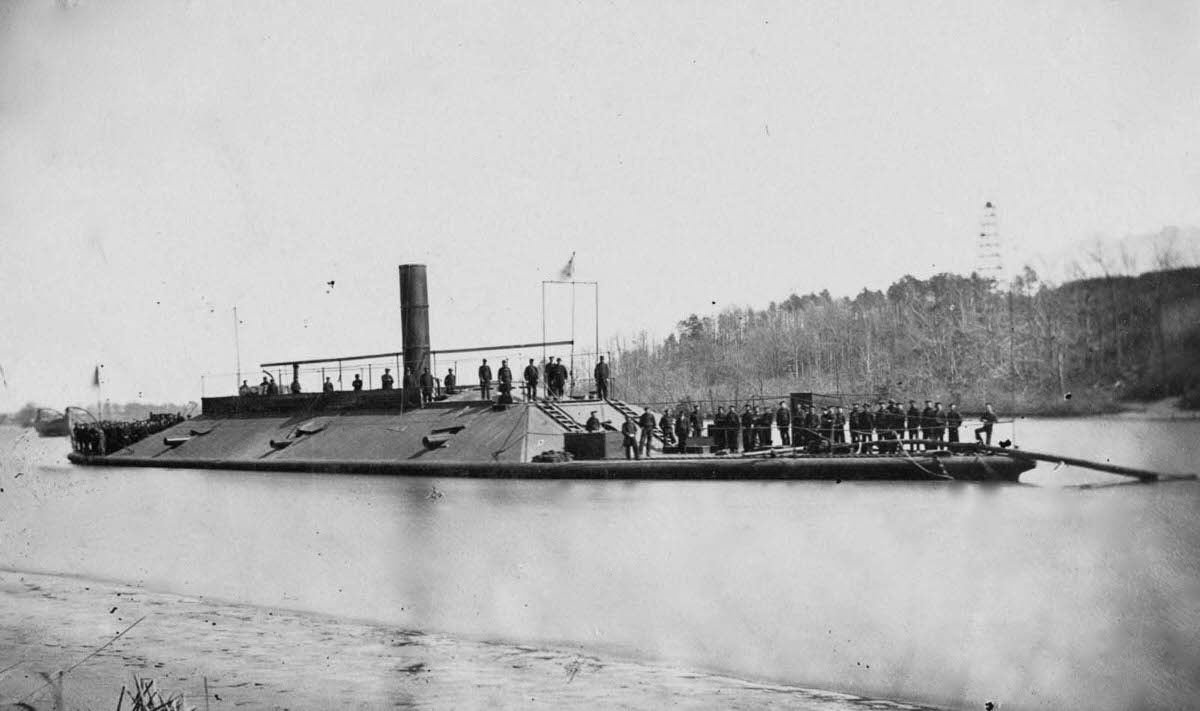
Low and broad on the water, the captured Confederate gunboat Atlanta sits like a dark wedge against a pale river, its armored casemate rising only slightly above the surface. A single smokestack and sparse deck fittings break the silhouette, while the shoreline behind it is quiet, wooded, and distant—an almost calm backdrop for a vessel built for brutal close-range fighting. The composition emphasizes how ironclads were meant to trade height and elegance for protection, turning the ship into a floating fort.
Along the top and near the bow, clusters of men stand in small groups, their presence giving scale to the Atlanta’s heavy plating and sloped sides. After capture by Union forces in 1864, scenes like this carried a powerful message: not just a prize of war, but proof that the contest for rivers and coastal approaches could hinge on technology, training, and timing as much as on numbers. Even without the roar of guns, the photo reads as a moment of transition—an enemy weapon now under watch, examined and controlled.
For readers interested in Civil War naval history, this image is a vivid window into the era of ironclads, blockades, and contested waterways, where ships like the Atlanta symbolized both innovation and desperation. Details in the hull form and deck arrangement hint at the practical realities of armored warfare: limited visibility, cramped working spaces, and the constant tension between mobility and defense. As a historical photograph, it invites closer looking—at the men aboard, the ship’s unusual profile, and the quiet river setting that belies the conflict that brought the Atlanta into Union hands.