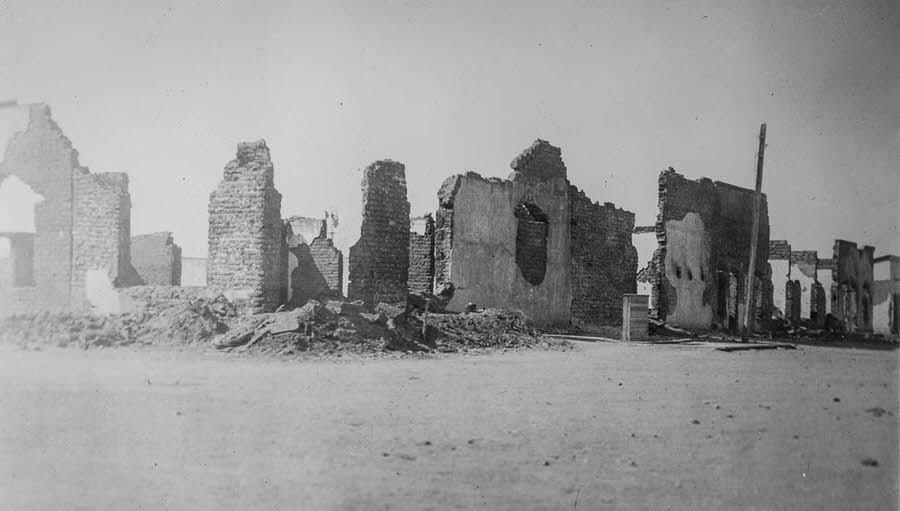
Ragged walls and roofless rooms line the edge of an empty street in Ciudad Juarez, leaving only brick stubs and shattered plaster to suggest where family homes once stood. The title’s reference to grenades feels painfully plausible as you scan the torn openings, the uneven silhouettes, and the heaps of debris that spill outward like frozen shockwaves. With no people in view, the scene reads as an aftermath—quiet, exposed, and unnervingly still.
Against a blank sky, the remaining masonry becomes a kind of accidental skyline, each broken section marking a different household’s loss. Details survive in fragments: arched doorways cut clean through ruined facades, partial interior walls that hint at former rooms, and isolated posts that stand where roofs and beams have vanished. It’s the architecture of civil conflict made literal, turning domestic space into a battlefield record.
For readers searching the history of Ciudad Juarez during periods of civil wars, this photograph offers more than destruction; it preserves evidence of how violence reaches ordinary neighborhoods. The wide, barren foreground underscores displacement, as if life has been pushed outside the frame along with furniture, belongings, and routines. In a single view, the image documents grenade damage to homes while also inviting reflection on rebuilding, memory, and the long shadow conflict casts over a city’s streetscape.