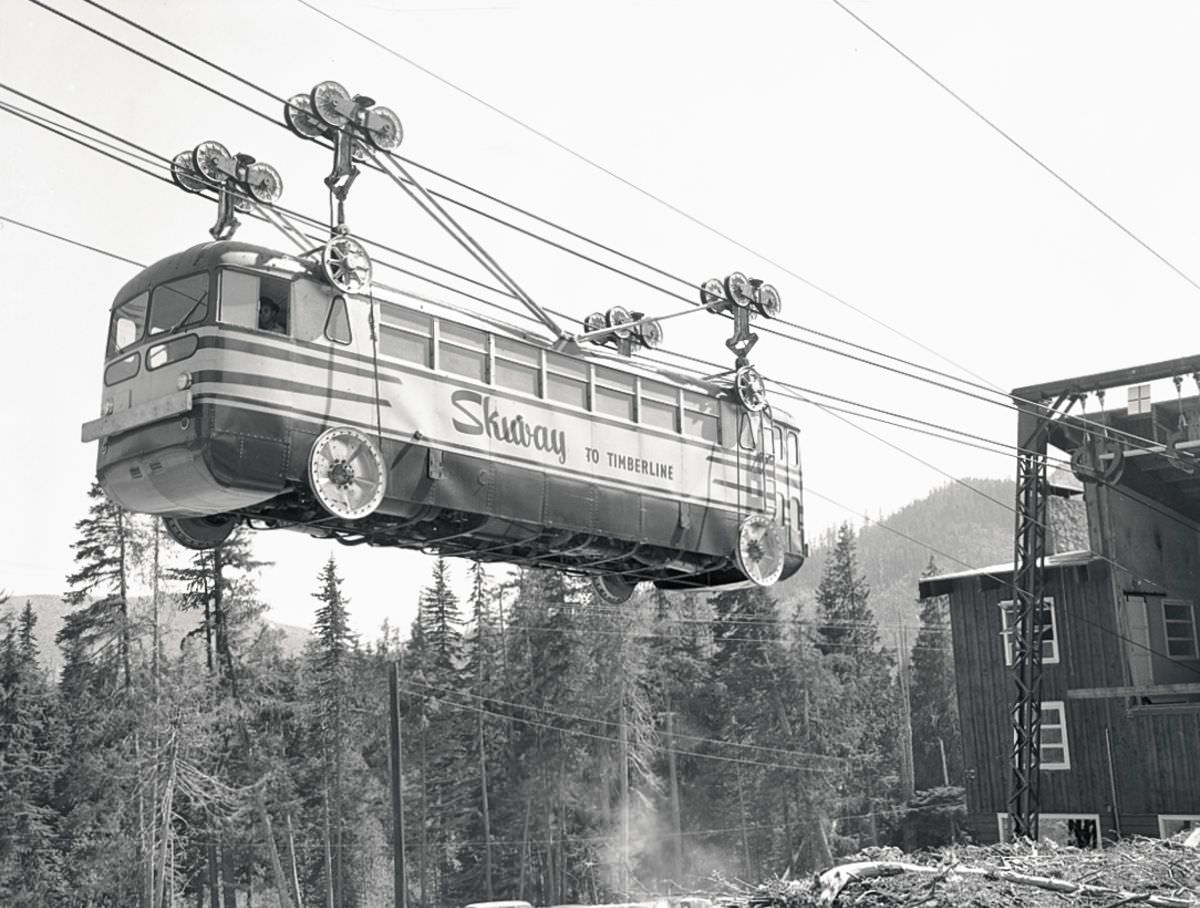
Suspended above the evergreens, a bus-like tramcar labeled “Skiway to Timberline” glides along thick cables, its roof crowded with sheaves and hardware that look more at home in a mill than on a mountain. The windows run in a neat row down the side, hinting at a warm, enclosed ride—an appealing promise in midwinter—while the rounded front and striped paint lend the machine a confident, streamlined profile. Off to the right, a timber building and support structure frame the scene, underscoring how much engineering stood behind this seemingly effortless float through the air.
January 1951 marked the first climb of the Mt. Hood Skiway tram from below Government Camp up toward Timberline Lodge, and the photo captures that moment of invention meeting landscape. Before modern chairlifts and gondolas became familiar fixtures at ski areas, enclosed aerial trams like this represented an ambitious answer to steep terrain and deep snow. The very design—part streetcar, part cableway—speaks to a postwar appetite for new experiences and new ways to reach high country comfort without the grind of a long winter ascent.
For anyone searching Mt. Hood history, Timberline Lodge skiing, or the evolution of Pacific Northwest winter recreation, this image offers a vivid reminder that infrastructure shapes adventure. The Skiway wasn’t just a ride; it was a corridor between communities and the mountain’s year-round playground, turning the journey itself into a spectacle. Seen today, the tram’s clean lines against the forested slope read like a snapshot of optimism—when getting uphill felt like stepping into the future.