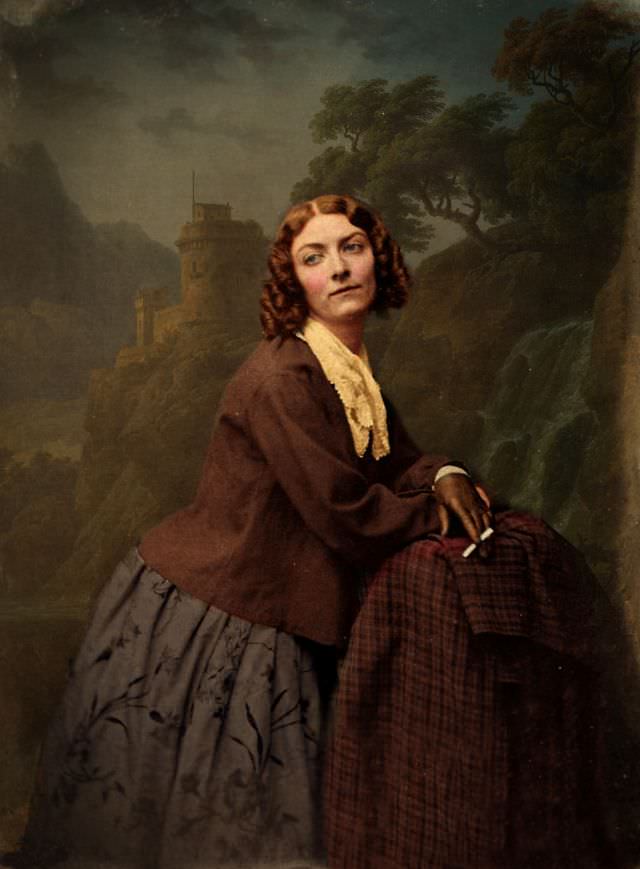
Lola Montez meets the viewer with a steady, slightly sidelong gaze, her ringlets carefully arranged and her posture composed as she leans on a draped support. The colorization brings out the warm brown of her jacket, the pale lace at her throat, and the soft textures of mid-19th-century dress, offering a vivid sense of presence that early photography so often kept restrained. Even her hand—resting with casual control—adds to the impression of a performer who understood how to command attention in stillness as well as onstage.
Behind her, a painted landscape backdrop conjures an Old World romance: dark trees, distant stone architecture, and a hazy sky that frames her figure like a theatrical scene. Such studio settings were more than decoration; they helped sitters craft a public identity, blending portraiture with performance and turning the camera into a new kind of stage. The contrast between the detailed costume and the atmospheric background gives the portrait a dramatic, almost narrative quality that suits an Irish singer known for cultivating intrigue.
Created in 1851 by the Boston photographers Southworth and Hawes, this portrait sits at the crossroads of celebrity culture and early American photographic art. Their studio was celebrated for refined lighting and careful posing, and the result here feels less like a mere record and more like a study in character. For readers interested in Victorian-era fashion, 19th-century portrait photography, and the construction of fame, this colorized image of Lola Montez offers an inviting doorway into the era’s visual storytelling.