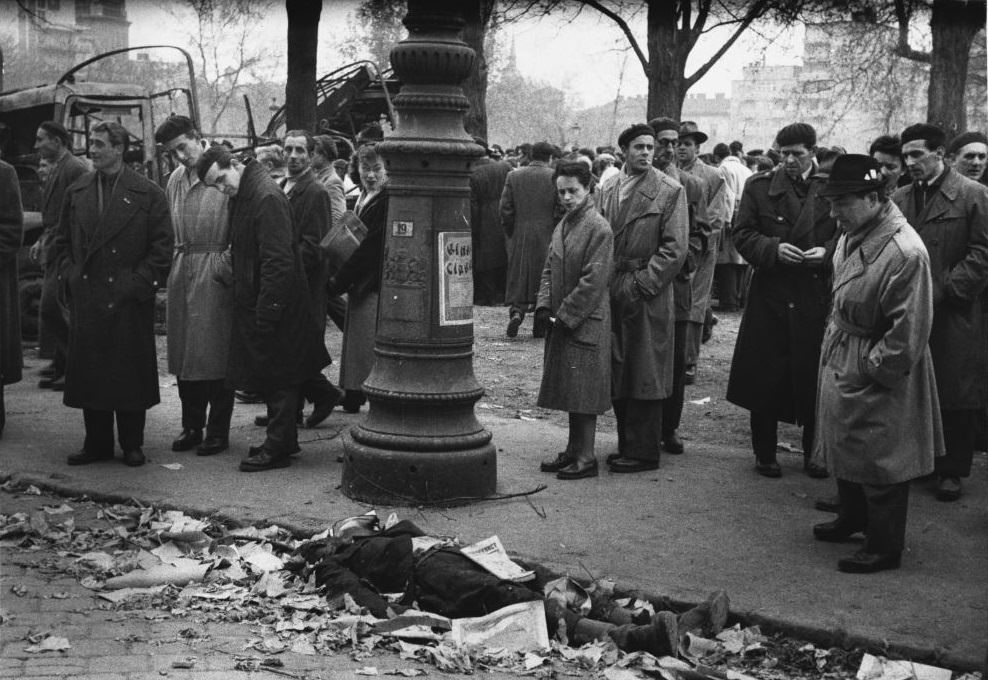
A line of onlookers gathers along a city street, coats pulled tight against the chill, faces fixed on what lies in the foreground. The scene is stark: a body on the pavement amid scattered papers and debris, while a lamppost and bare trees frame the crowd like a grim stage set. Some stare openly, others glance down and away, but no one seems untouched by the moment.
The title places this in Hungary’s 1956 revolution and identifies the dead man as connected to the A.V.H., the notorious secret police whose presence shaped daily life through fear and surveillance. That context helps explain the charged stillness here—public curiosity mixed with anger, relief, and disbelief as authority collapses into vulnerability. In the background, the street feels disturbed and half-ruined, hinting at recent upheaval and the speed with which order can fracture during civil conflict.
What makes the photograph linger is how ordinary the witnesses appear: workers, students, and passersby temporarily transformed into a silent jury by events beyond any single person’s control. It’s a brutal reminder that revolutions are not only banners and speeches but also bodies, reckoning, and crowds trying to understand what comes next. For readers searching the history of the Hungarian Revolution of 1956, the A.V.H., and the human cost of political violence, this image offers an unfiltered window into the revolution’s street-level aftermath.