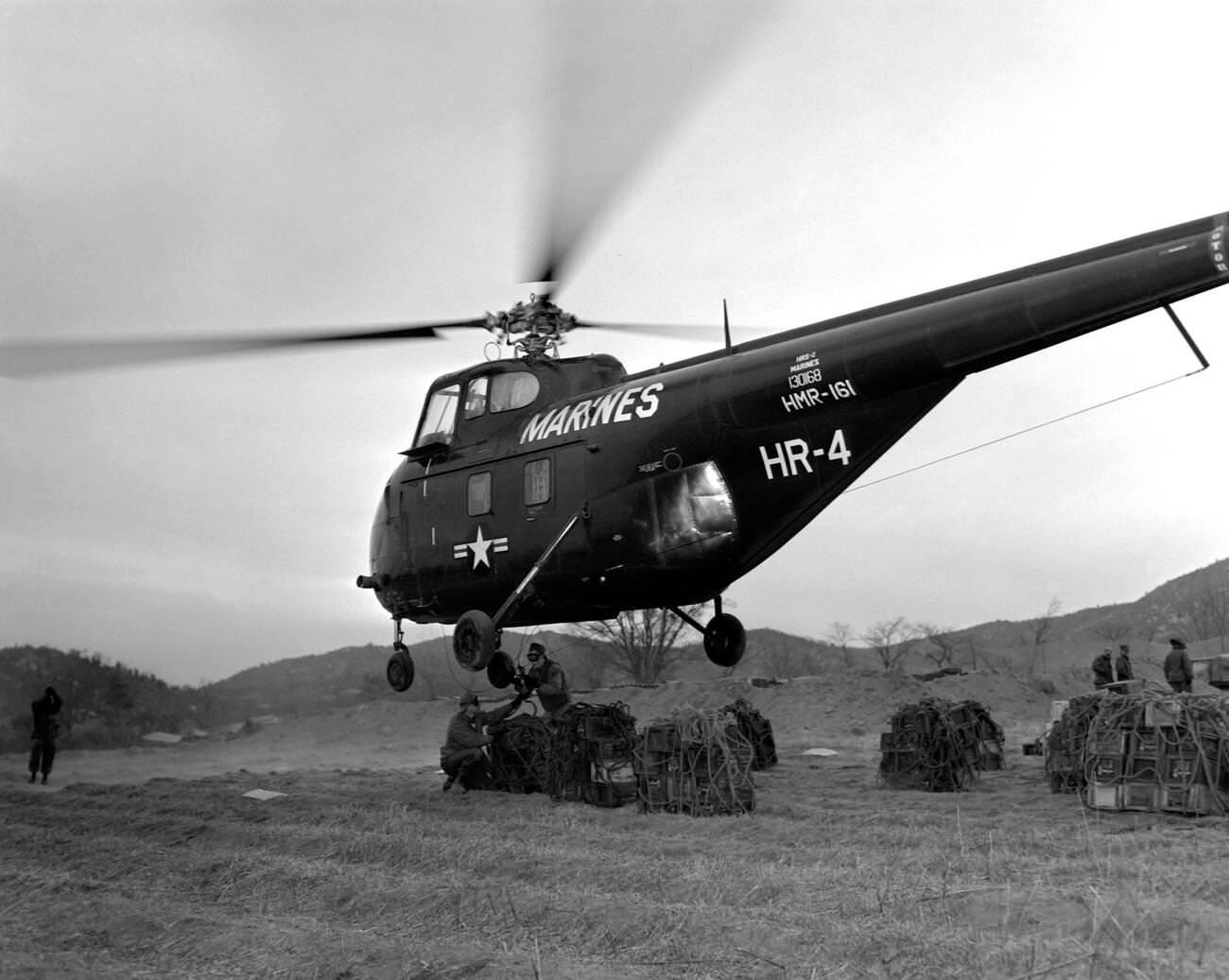
Rotor wash blurs the sky as a Sikorsky HRS-2 hovers just feet above a rough field, its “MARINES” markings and the designation “HR-4” standing out against the dark fuselage. Below, bundled cargo loads sit in netting and straps while a small group of Marines works close to the landing gear, guiding the aircraft in during a tense, practical moment of supply handling. Low hills and scattered figures in the background place the scene in open country rather than a prepared airstrip, emphasizing how quickly helicopters could bring lift and mobility to difficult ground.
In the 1950s, the HRS-2 represented a turning point in military aviation: not a glamorous fighter silhouette, but a workhorse built for the unglamorous essentials—moving people, hauling equipment, and sustaining units far from roads. The photo’s tight focus on sling-ready bundles and ground crew coordination highlights the new choreography of vertical lift logistics, where timing, signals, and careful positioning mattered as much as horsepower. Even without a visible date or location, the imagery speaks to an era when helicopter operations were becoming routine parts of Marine planning and field practice.
Collectors and researchers interested in Cold War-era military history will find plenty to study here, from the stenciled text near the tail boom to the airframe’s distinctive profile and landing stance. Details like the cargo nets and the spacing of personnel suggest the controlled urgency of real-world operations, a snapshot of training or active support rather than a posed publicity still. As a historical photo of a Sikorsky HRS-2 helicopter in the 1950s, it captures the texture of early Marine helicopter doctrine—measured, hands-on, and shaped by the demands of conflict and readiness.