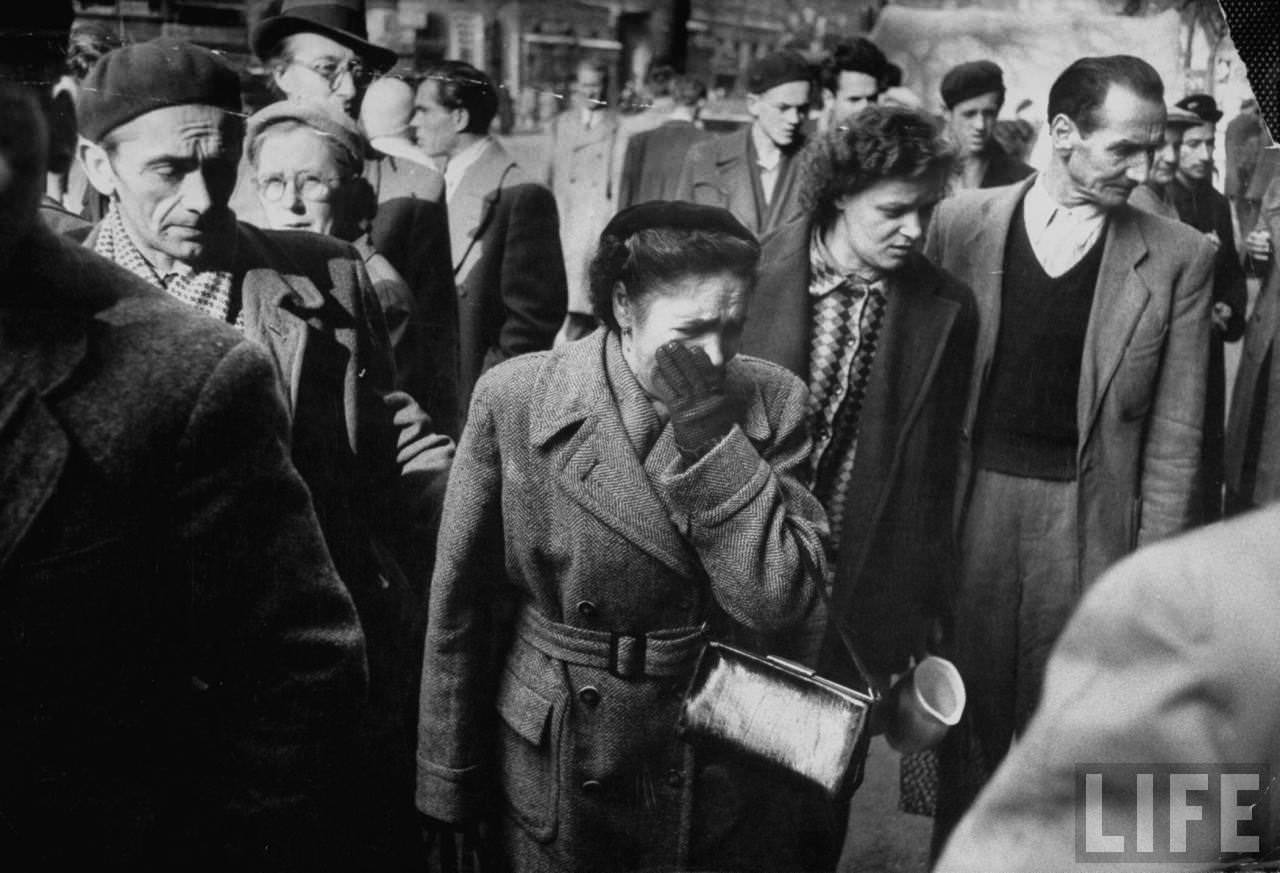
A tight knot of civilians fills the street, their coats and hats blending into a single, restless mass as they push forward through the smoke and confusion of revolt. At the center, a face twists with strain—half grimace, half grief—while those nearby glance sideways, wary and exhausted, as if every sound might signal another burst of violence. The scene feels improvised and urgent, the kind of crowd that forms when ordinary life collapses and survival becomes a collective act.
The title’s reference to a Hungarian uprising against a Soviet-backed regime frames this moment as more than a passing street disturbance; it is a snapshot of civil conflict in a capital under pressure, where resistance and repression collide at close range. There are no banners or speeches here, only expressions—tight jaws, downcast eyes, and bodies leaning into one another—suggesting fear, solidarity, and the hard calculus of deciding whether to keep moving or turn back. Even without explicit landmarks, the photograph speaks in the universal language of revolution: anonymity, vulnerability, and defiance.
For readers searching for Hungarian Revolution history, Cold War-era unrest, and candid wartime photojournalism, this image offers a raw, human-scale view of political upheaval. It captures how revolutions are lived not only by fighters and leaders, but by pedestrians caught in the churn of rumors, crackdowns, and hope. In that grimace lies a story of patriotism tested by street-level reality—an emotional record of a civil struggle that still echoes in the memory of 20th-century Europe.