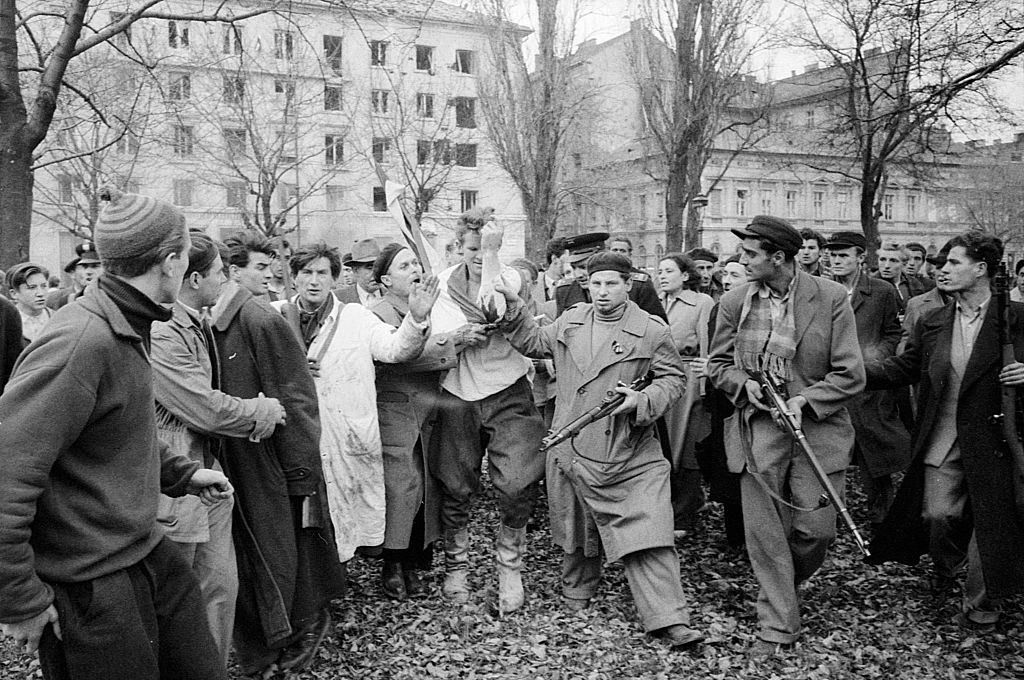
Bare trees and damp leaves frame a tense street scene in Budapest during the Hungarian Revolution of 1956, when authority fractured and crowds began policing the police. A cluster of civilians and armed rebels presses inward, their faces tight with urgency, as an injured officer of the Hungarian political police is pulled forward through the throng. The surrounding apartment blocks and institutional buildings loom like silent witnesses, turning an ordinary courtyard into a stage for a civil conflict unfolding in real time.
At the center, the captive’s raised hands and unsteady posture suggest pain, fear, or surrender—an instant when power reverses and the outcome is uncertain. Around him, rifles are carried at the ready, yet the crowd includes unarmed men and women as well, underscoring how revolution blurs the line between bystander and participant. The camera catches not only a detention but also the volatile atmosphere of October 30, 1956, when rumors, revenge, and hope collided in the streets of the Hungarian capital.
Such images remain among the most unsettling documents of the era because they refuse easy moral clarity: they show both the collapse of a repressive apparatus and the perilous justice that can follow. For readers searching the history of the Hungarian political police, the Budapest uprising, or civil wars and revolutions in Eastern Europe, this photograph offers a stark entry point into the human stakes of 1956. It preserves the raw immediacy of a moment when the crowd believed history could be seized by hand, even as the city around them stood scarred and waiting.