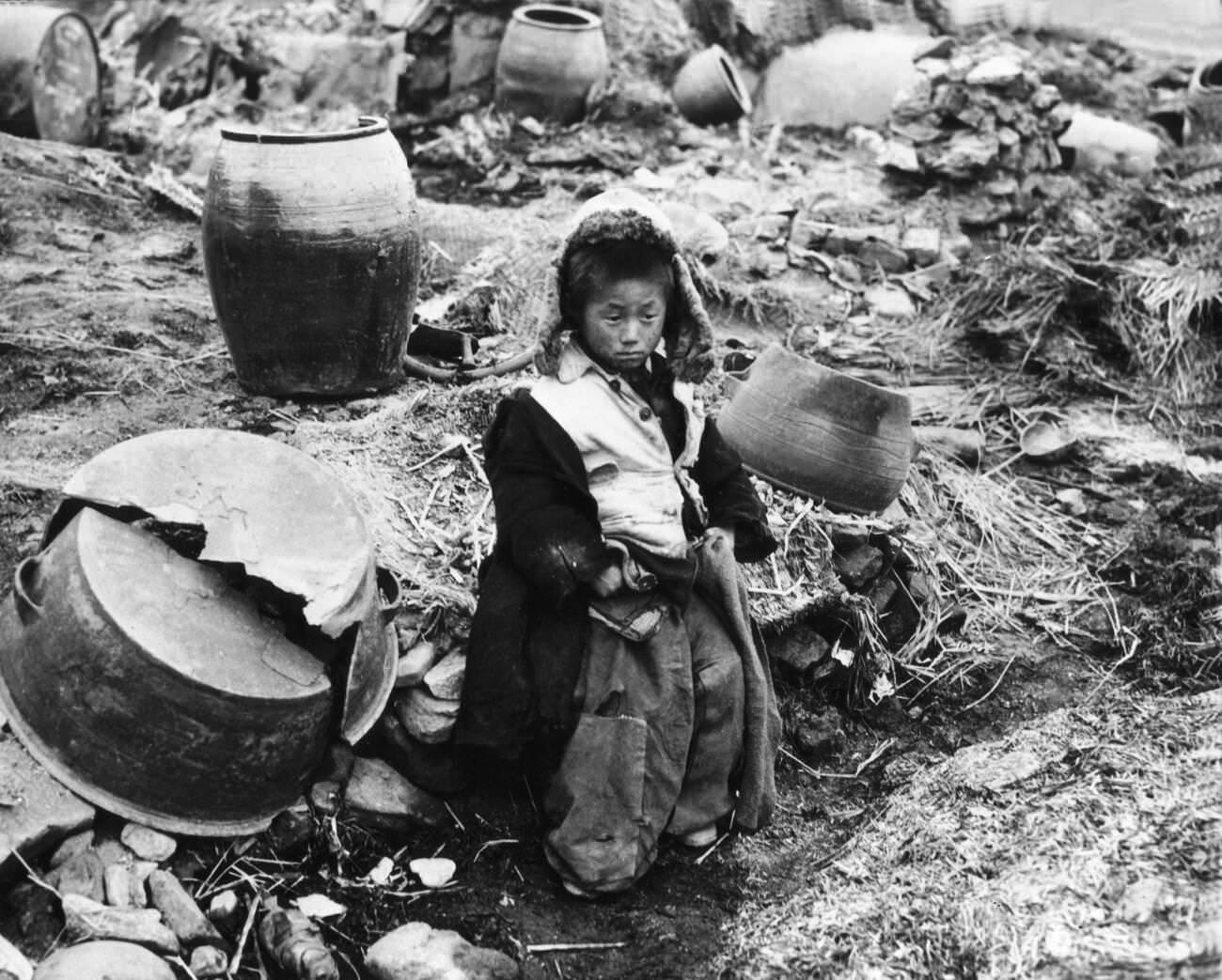
Alone amid broken earth and scattered household jars, a young Korean child sits bundled in layered, worn clothing, their gaze lowered with an exhaustion that feels far older than their years. The shattered pottery in the foreground and the toppled vessels behind them hint at a home life abruptly interrupted, with the landscape reduced to fragments of what once held food, water, and routine. In the stark tonal range of the photograph, every crack and crease reads like evidence of survival after upheaval.
The title, “Korean orphan, 1950s,” places the scene in the long aftermath of civil wars and the wider conflict that tore through the peninsula, when displacement and loss left countless children without stable families or shelter. Rather than offering spectacle, the camera lingers on the quiet weight of deprivation: empty ground, scattered debris, and a solitary figure occupying the space where community should be. It is a portrait of wartime childhood not through uniforms or battlefields, but through the ordinary objects of domestic life turned into ruins.
For readers searching for Korean War history, 1950s Korea, or photographs of orphans and refugees, this image serves as a sobering entry point into the era’s civilian experience. The jars—icons of everyday storage and sustenance—become visual symbols of scarcity when cracked open and abandoned, framing the child as both witness and survivor. In remembering this moment, we are asked to consider not only the violence of conflict, but the slow, persistent struggle to rebuild lives when family, home, and certainty have been stripped away.