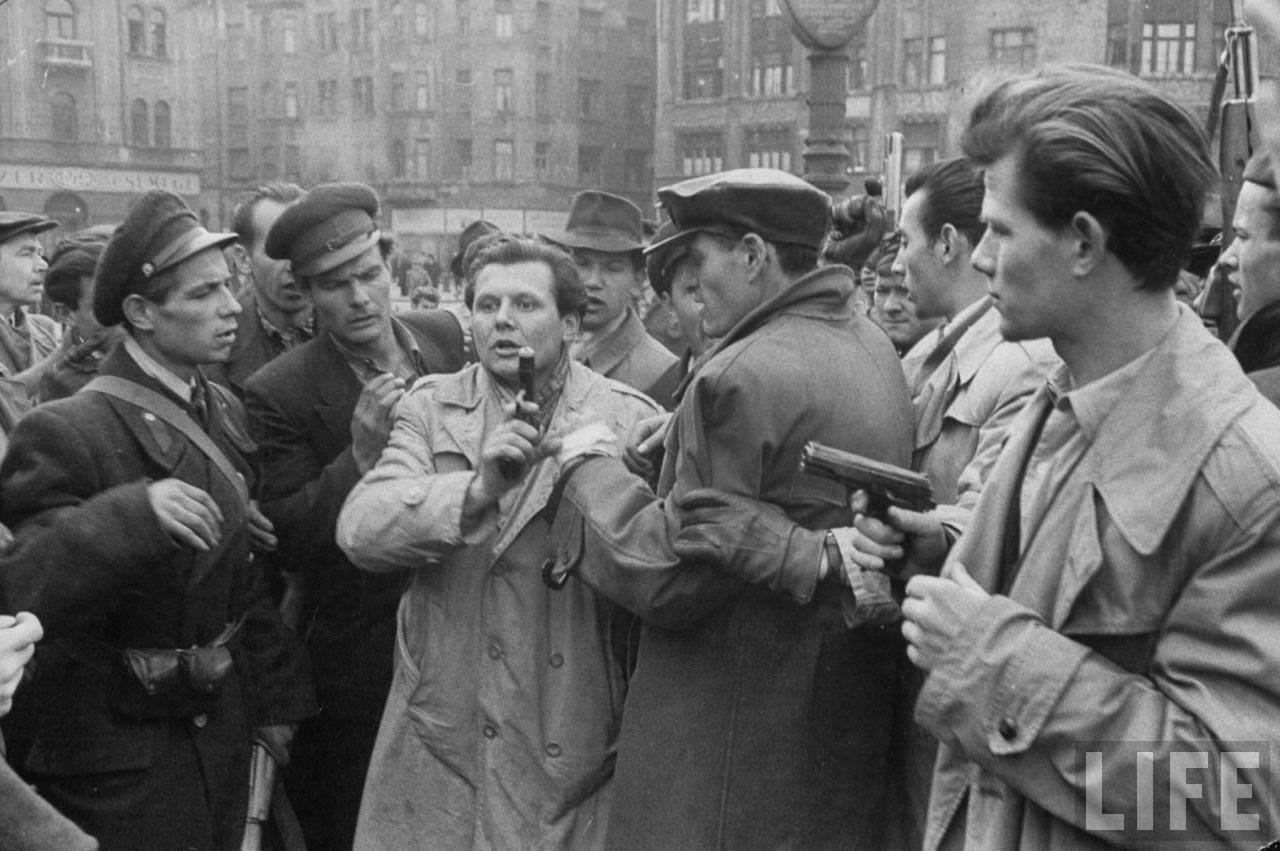
Tension hangs over a crowded city street as a knot of armed men closes in around a civilian figure who appears to be speaking urgently, finger raised as if making a point. Coats, caps, and worn jackets signal the everyday background of these Hungarian freedom fighters, people pulled from ordinary life into the chaos of revolution against a Soviet-backed regime. In the foreground, a pistol is gripped tightly, a stark reminder of how quickly politics turned into street-level danger.
Behind the faces and gestures, tall apartment buildings and storefronts frame the confrontation, placing the drama in a lived-in urban neighborhood rather than a distant battlefield. The scene reads like an impromptu checkpoint or heated debate—part negotiation, part coercion—where loyalties and accusations could change by the minute. Even without visible insignia or a clear banner, the clustering bodies and guarded stares convey the brittle uncertainty of civil conflict.
As a historical document, the photograph illustrates how revolutions are often decided in close quarters: in crowds, at corners, and through the pressure of persuasion backed by weapons. It also captures the uneasy mix of solidarity and suspicion that marks uprisings, when authority fractures and new power structures form on the fly. For readers searching for Hungarian Revolution history, Cold War unrest, and the human texture of anti-communist resistance, this image offers a raw, immediate window into the struggle.