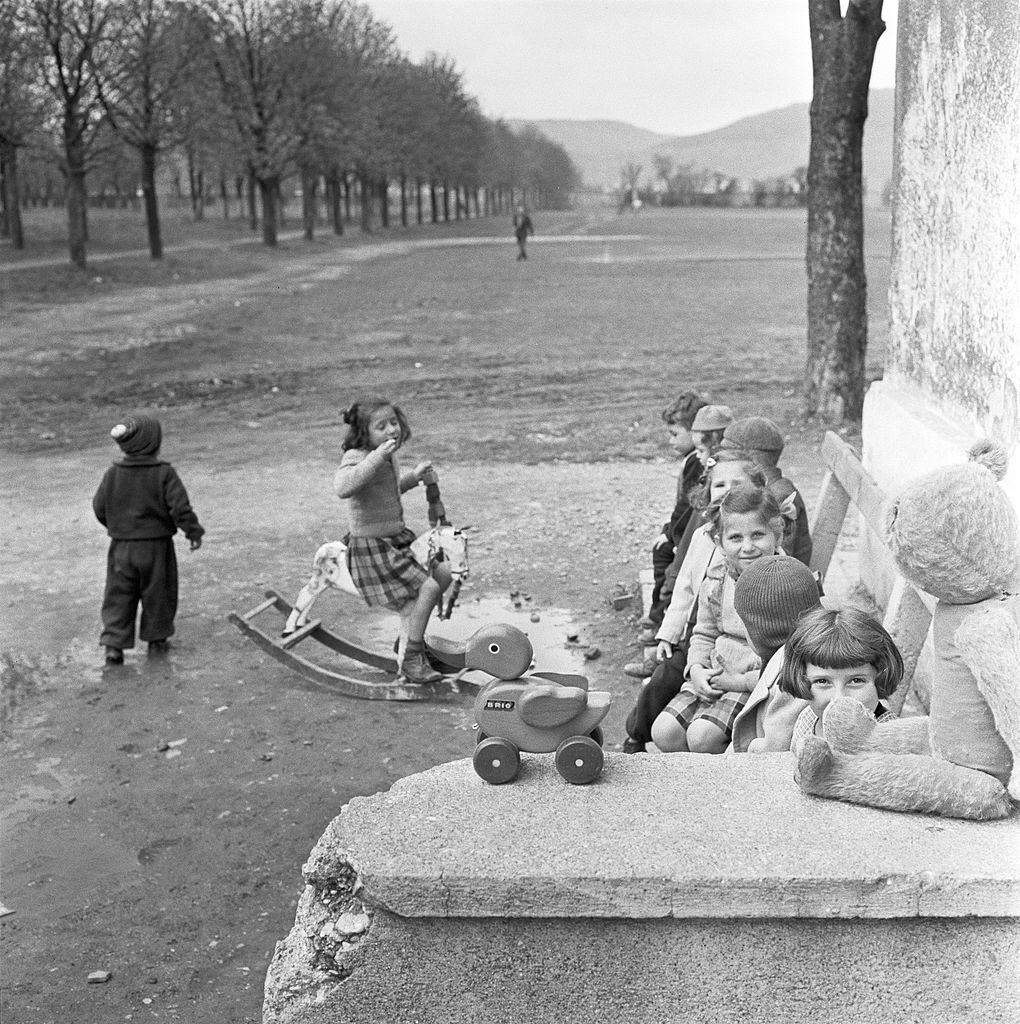
Along a bare-winter avenue lined with leafless trees, a cluster of Hungarian refugee children gathers beside a rough camp wall, their small bodies bundled in knit caps and heavy coats. Some perch on a low ledge, others wait in a loose row, and one child turns toward the camera with an expression that sits somewhere between curiosity and caution. A simple rocking toy and a wooden pull-along duck in the foreground hint at an improvised childhood, where play survives in the cracks of displacement.
The title’s “1956” points to the wider shockwaves of civil unrest and forced flight that pushed families across borders and into temporary shelters. In the open ground beyond the children, the landscape stretches out emptily, emphasizing how camps often sat at the edge of ordinary life—near fields, roads, or military grounds—neither fully home nor fully away. What stands out is the ordinariness of the scene: not dramatic action, but waiting, watching, and making do.
For readers searching for a 1956 Hungarian refugee camp photo, this image offers a grounded glimpse of what exile looked like at child height: a line of faces, a borrowed space, and toys that could fit in a hand. The soft focus of the distant hills contrasts with the sharp presence of the children up close, reminding us how historical upheaval is lived most intensely in small moments. It’s a quiet record of resilience—of children finding routine and companionship even as their world has been abruptly rearranged.