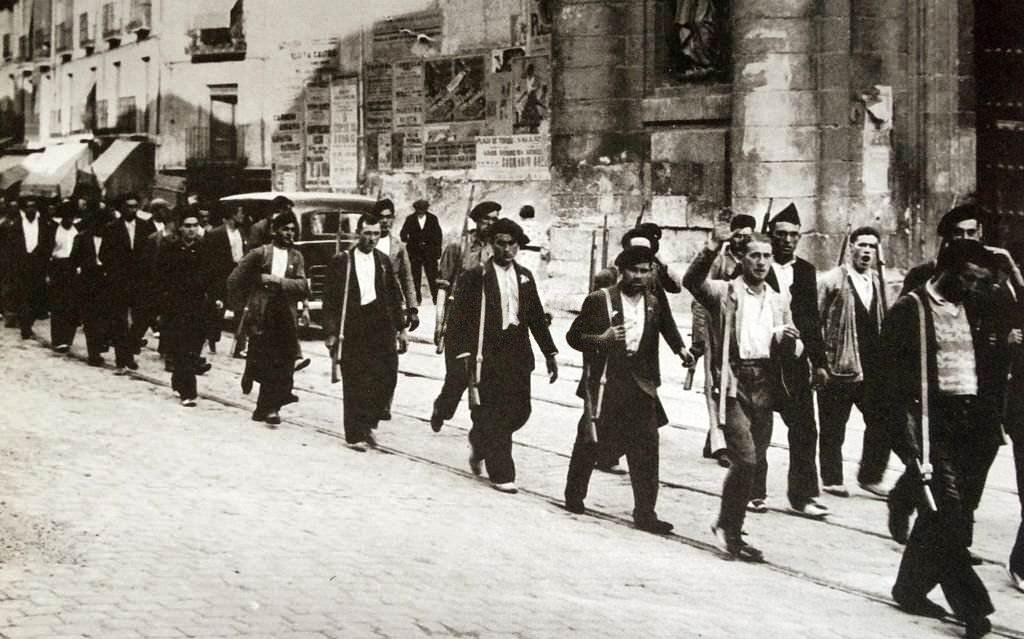
Streetcar rails cut through a cobbled avenue as a column of armed peasants advances in loose formation, their jackets unbuttoned and caps pulled low against the glare. Rifles hang from shoulders or are carried at the ready, while a few men gesture mid-stride, faces set with the tense purpose of people pulled suddenly from farmwork into war. Behind them, pedestrians and onlookers keep pace along the edges of the street, turning an ordinary urban thoroughfare into a corridor of mobilization.
Posters and pasted notices blanket the walls, a dense paper backdrop that hints at the propaganda battles and urgent announcements of the Spanish Civil War in 1936. The mix of civilian clothing and weaponry underscores how quickly the Republican side drew on local militias and rural workers, blurring the lines between soldier and neighbor. A car tucked near the curb and the heavy stone architecture add period texture, placing the march in the lived, everyday spaces of a city rather than on a distant battlefield.
Toward Valladolid, the title suggests, these men move as part of the Republican army’s early-war effort to organize resistance and project control across contested territory. Their uneven spacing and varied kit speak to improvisation—units forming in haste, armed with what could be found, and propelled by conviction as much as by command. For readers searching Spanish Civil War history, Republican militia photos, or 1936 Spain, the scene offers a stark reminder of how political crisis remade streets into front lines and civilians into combatants.