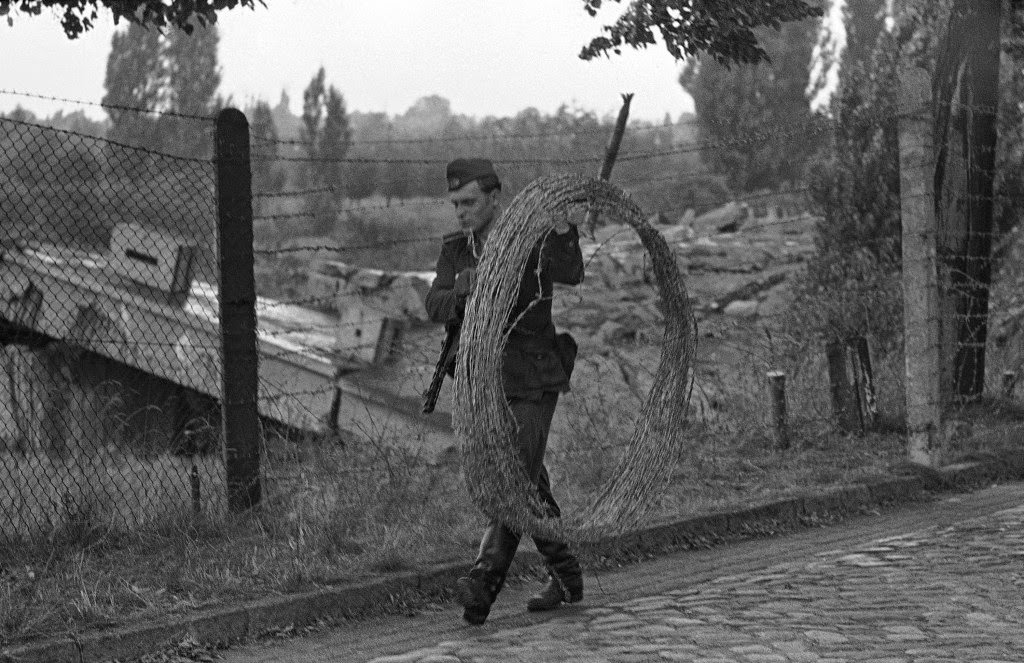
A lone East German soldier strides along a rough roadside, balancing an oversized coil of barbed wire that nearly frames his whole body. Behind him, a simple fence line, posts, and scrubby greenery hint at a border in the making—more improvised than monumental, yet already unmistakably restrictive. The photograph’s quiet tension lies in its ordinariness: one man, one roll of wire, and the mundane labor of turning a political decision into a physical barrier.
Dated August 21, 1961, the scene sits in the immediate aftermath of the abrupt sealing of Berlin, when temporary obstacles and patrols were rapidly transformed into a hardened frontier. The title places this moment along the boundary separating the British and Soviet sectors, a fault line of the Cold War where everyday streets and footpaths became contested edges. Barbed wire, cheap and fast to deploy, served as an early tool of separation—an instant warning that movement would no longer be taken for granted.
Details in the frame—the soldier’s uniform and weapon, the curve of the wire, the patchy ground and scattered materials—underscore how quickly a city can be remade by security measures. For readers searching the history of the Berlin Wall’s first days, this image offers a stark reminder that walls begin as work: carried, unrolled, and anchored into place. It’s a snapshot of division under construction, capturing the moment Berlin’s border started to harden into something that would shape lives for decades.