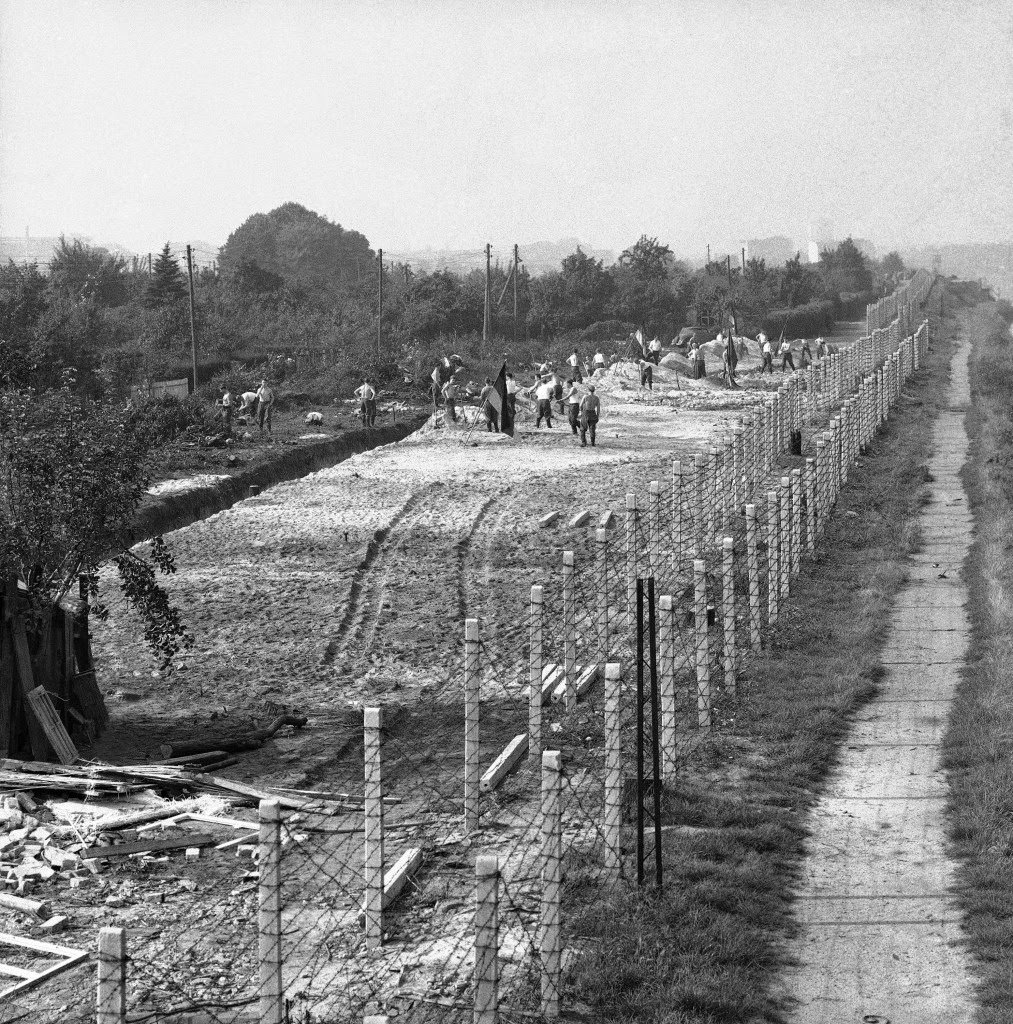
Along a raw, scraped corridor at the edge of divided Berlin, laborers are seen leveling earth and extending a long line of posts and wire—early work on what soon became known as the “Death Strip.” The perspective pulls the eye down the border: a cleared band of ground, disturbed by tracks and footprints, sits beside a stark barrier that hardens the landscape into an enforced boundary. In the distance, scattered trees and low silhouettes of the city soften the horizon, making the engineered emptiness in the foreground feel even more deliberate.
Men cluster in small groups across the newly exposed soil, some bent to their tasks, others standing as if waiting for instructions or materials. The scene reads like construction, yet the purpose is unmistakably political: creating visibility, control, and a zone meant to deter movement. The plain geometry of fencing and the widening strip of bare ground convey how quickly a living urban edge was converted into a fortified system.
Taken in the tense early months after the Berlin Wall’s erection, the photograph documents how communist authorities on the East Berlin side transformed an ordinary border line into a managed space of surveillance and separation. For readers tracing Cold War history, Berlin Wall construction, and the everyday mechanics of state security, this image offers a grounded look at the labor behind the barrier—work that reshaped neighborhoods and redefined freedom of movement with stakes far beyond the worksite.