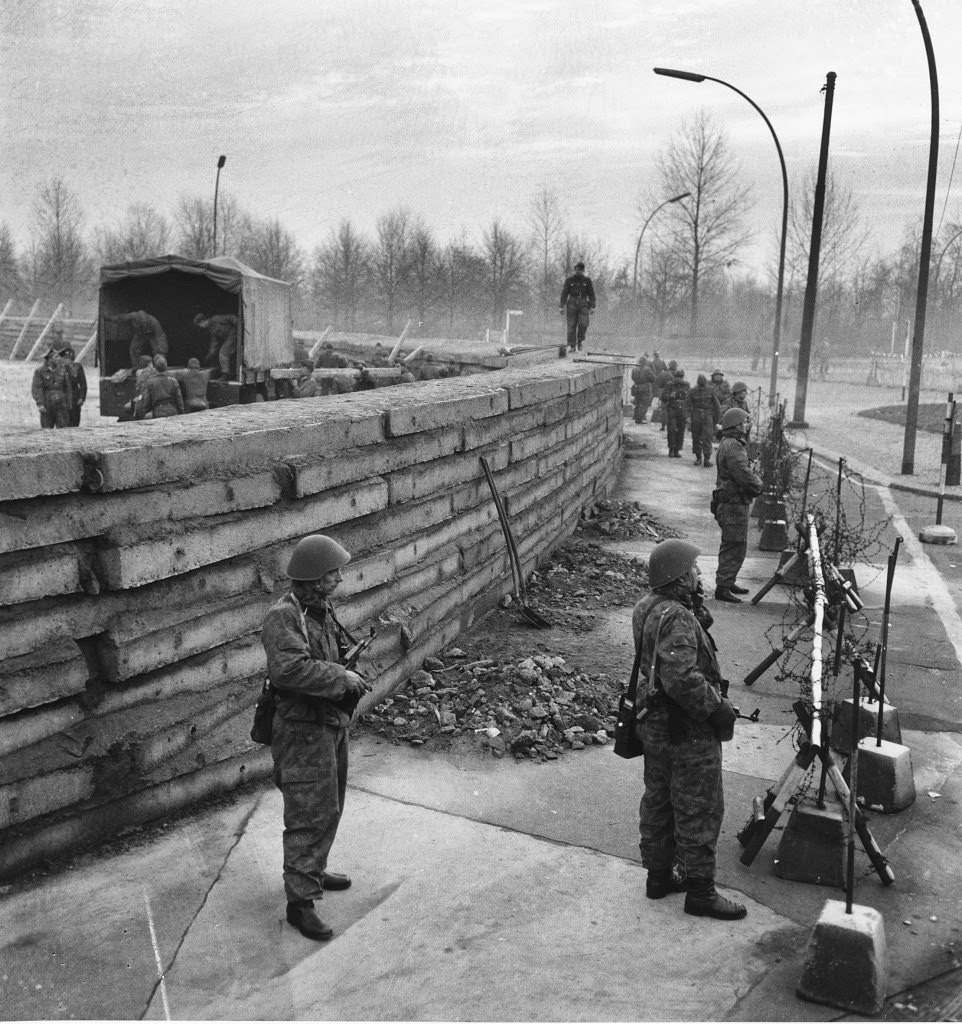
Barbed wire curls along the roadside as West Berlin police hold their positions beside a newly erected stretch of massive concrete near Brandenburg Gate. Helmets and rifles, watchful stances, and the stark geometry of stacked slabs turn a familiar city approach into a militarized corridor. Even the streetlamps and bare winter trees seem to lean into the tension, framing a frontier that has been forced into existence.
Near the top of the wall, a lone figure walks the length of the barrier, while others cluster by a covered truck and the rough piles of rubble left by hurried construction. The scene feels unfinished yet irreversible: temporary fencing, improvised checkpoints, and a roadway narrowed by obstacles suggest a city being partitioned in real time. In the foreground, the barbed wire and equipment emphasize not only security but also the fear of sudden movement—who might cross, who might flee, who might be stopped.
Dated Nov. 23, 1961, the photograph places viewers in the early days of the Berlin Wall, when concrete and wire were still settling into their role as Cold War architecture. At Brandenburg Gate—long a symbol of Berlin itself—the wall’s presence becomes both political statement and daily reality, separating streets, routines, and lives. For readers searching Berlin Wall history, Cold War Berlin, or Brandenburg Gate 1961, this image offers a sobering look at how quickly borders can harden into permanence.