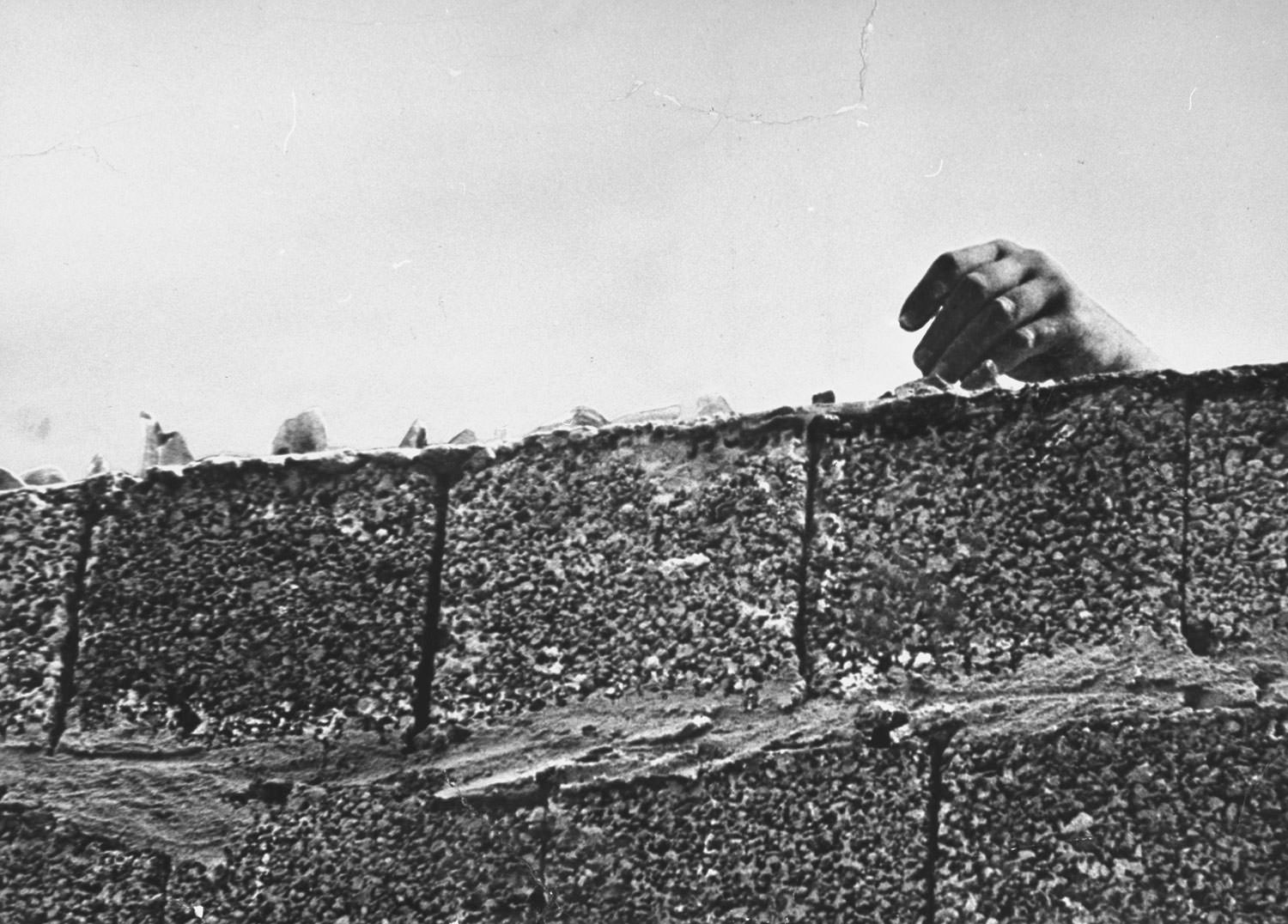
A single hand rises into view above the rough, newly divided edge of Berlin, its fingers hovering over a jagged line of broken glass. The wall below fills the frame with coarse concrete blocks and dark mortar seams, while the pale sky offers no distraction—only emptiness, like a pause held too long. That contrast between open air and hard barrier turns a small gesture into a striking symbol of the Berlin Wall’s earliest days in August 1961.
Shards along the top catch the light and look almost like teeth, a blunt warning to anyone tempted to climb, reach, or reunite with what lay on the other side. The person remains anonymous, reduced to a hand and wrist, yet the intimacy of that detail suggests urgency: a search for contact, a test of the boundary, or a moment of defiance under watchful eyes. In the early Cold War atmosphere, separation was enforced not only by policy but by materials—glass, stone, and fear made physical.
Seen today, the photograph reads as both documentary evidence and quiet storytelling, distilling a vast geopolitical crisis into one human-scale moment. It invites readers to consider how quickly borders can be imposed and how ordinary lives are reshaped when a city is split overnight. For anyone exploring Berlin Wall history, August 1961, or the lived experience of division, this image lingers as a reminder that even the smallest reach can carry the weight of an era.