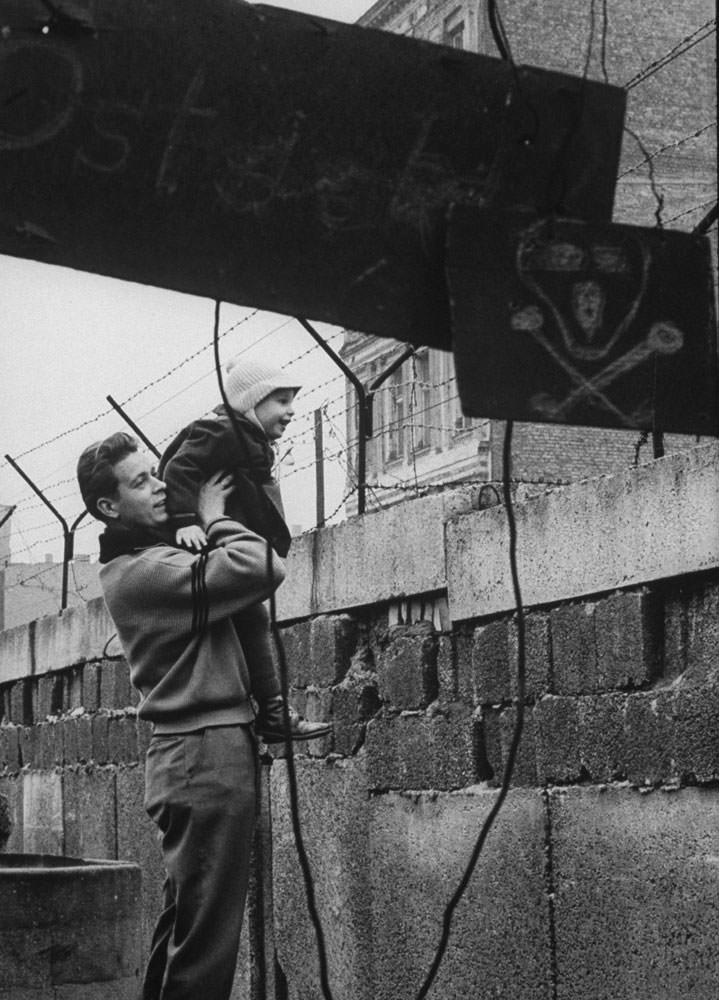
A father in West Germany braces his footing against rough masonry and lifts his small son high enough to look over the newly raised barrier of 1961. The boy’s knit cap and bundled coat suggest a chilly day, yet his attention is fixed beyond the concrete blocks and the angled lines of barbed wire. Above them, a dark banner hangs like a lid on the sky, amplifying the sense of enclosure that the Berlin Wall brought to ordinary streets.
Up close, the textures tell the story: uneven stones stacked into a hurried wall, wire strung and braced to deny even a curious glance, and buildings looming behind the boundary as if the city itself has been cut in two. The father’s posture is steady and deliberate, a practical act of lifting that becomes symbolic—an attempt to grant his child one last, safe view of the “other side.” In that simple motion, the Cold War turns from geopolitics into family scale, measured in inches of height and seconds of sight.
Within the wider history of Berlin, scenes like this became quiet markers of separation, loss, and resilience as the border hardened into an everyday reality. The photo speaks to the human cost of division: not only the blocked routes and broken neighborhoods, but the sudden need to teach a child what walls mean. For readers searching Berlin Wall 1961 history, West Germany daily life, or Cold War Germany photographs, this moment offers an intimate doorway into a divided city’s most personal memories.