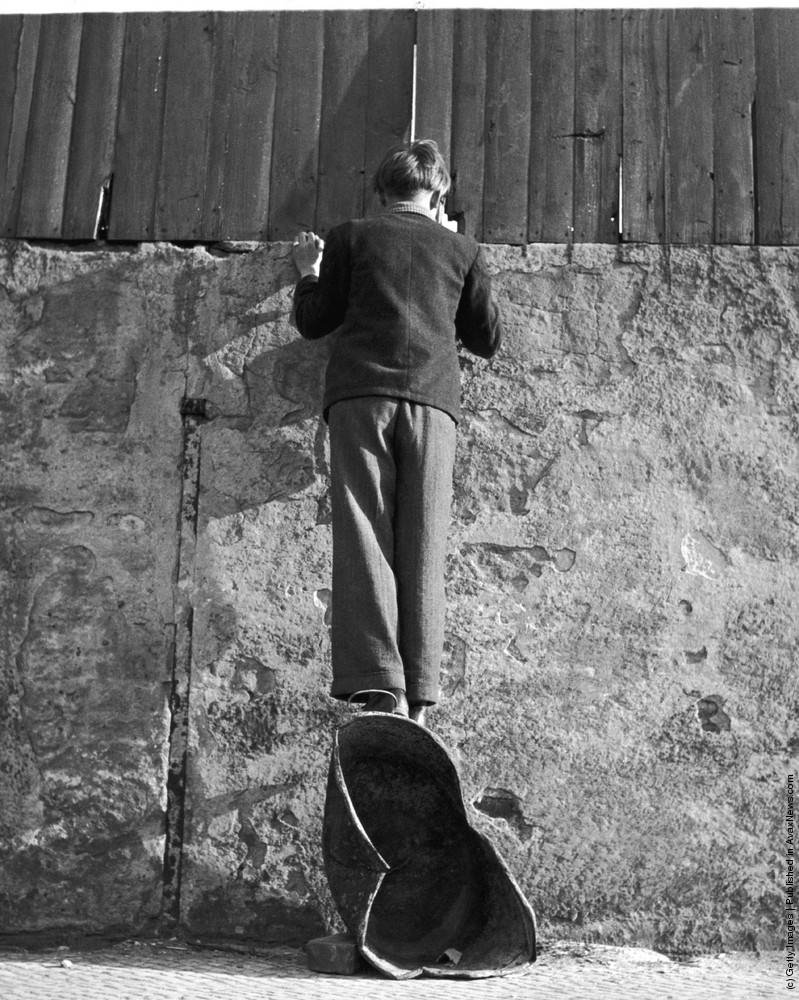
Perched on an upturned coal scuttle, a boy stretches himself tall enough to see beyond a rough wall topped with planks, his hands gripping the edge as if it were the rail of a grandstand. The camera catches him from behind, all angles and balance—small shoes on metal, trousers hanging straight, the back of a sweater framed against stone and timber. It’s a simple act of curiosity made dramatic by the improvised pedestal and the hard, weathered textures of the stadium boundary.
Berlin in January 1961 is written into the scene even without the crowd: a city of barriers, thresholds, and daily improvisation, where the promise of sport and spectacle can sit just out of reach. The wall reads as both mundane architecture and a quiet metaphor, separating the public world of the stadium from the street outside. The boy’s determination to peer over it feels like a child’s version of the larger tensions of the era—wanting to look in, wanting not to be excluded.
Details like the chipped masonry, the uneven boards, and the battered coal scuttle anchor this historical photo in ordinary postwar life, when coal was still a familiar presence and resourcefulness a necessity. As a moment of street photography and social history, it also makes a strong visual story for readers searching for “Berlin 1961,” “sports stadium wall,” or “coal scuttle” imagery. In one quiet frame, the everyday and the political meet: a child’s curiosity set against the architecture of division.