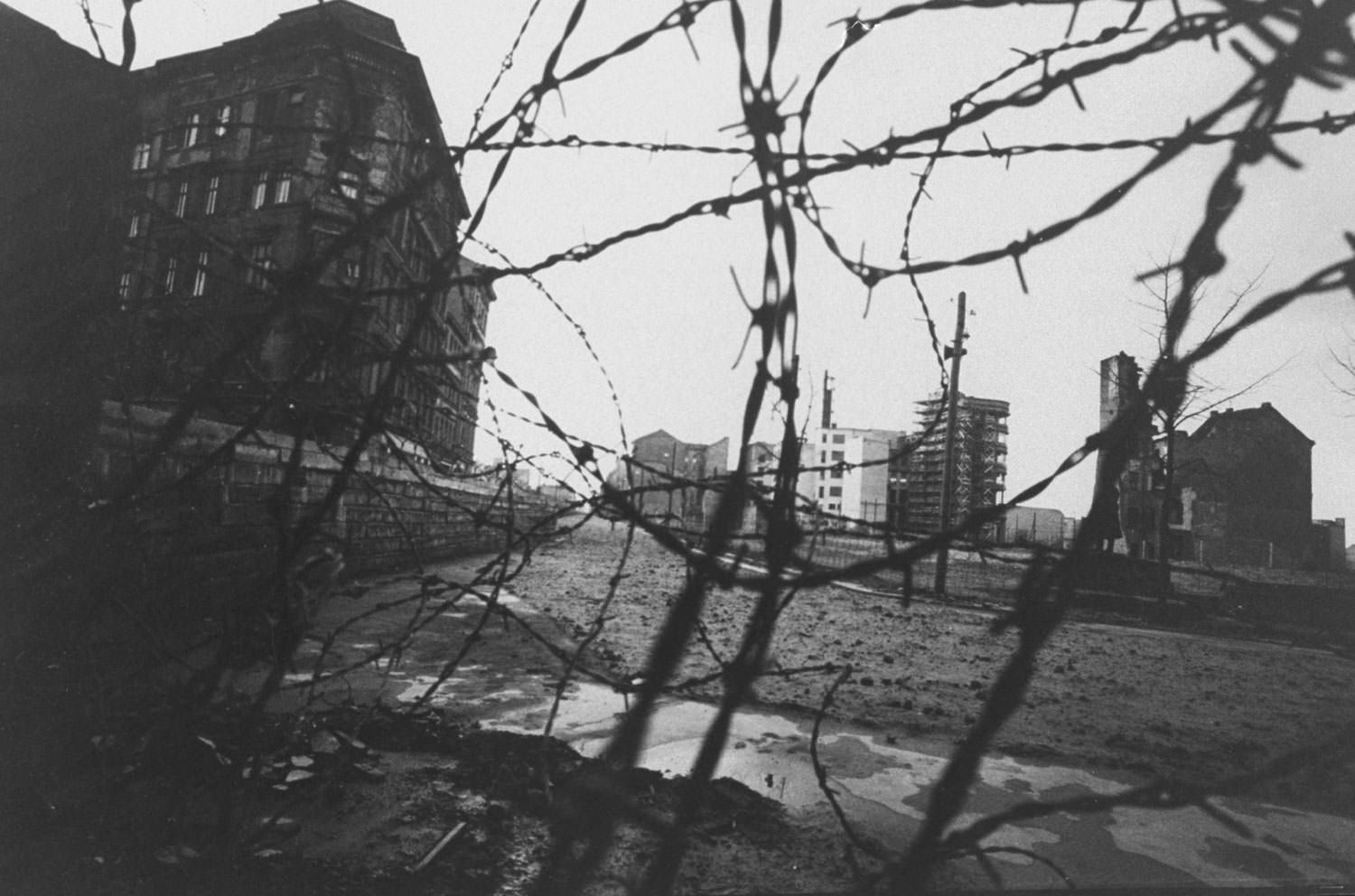
Barbed wire dominates the foreground in a harsh, improvised lattice, turning the viewer’s line of sight into a struggle—exactly the point in divided Berlin in December 1962. Beyond the snarled strands, the city appears fractured and unsettled: a dark, hulking building on the left, scattered structures and poles in the middle distance, and an expanse of rough ground that feels more like a scar than a street. The camera’s placement makes the barrier feel intimate and unavoidable, as if the border has crept right up to the lens.
Winter light flattens the scene into hard contrasts, lending the wire an almost calligraphic violence against the pale sky. Puddles and muddy patches suggest an in-between zone—neither fully urban nor open countryside—where everyday routes and familiar neighborhoods had been abruptly severed. In this Cold War landscape, architecture becomes backdrop to something more immediate: the physical mechanics of separation, rendered in metal barbs and tight, defensive angles.
December 1962 sits early in the life of the Berlin Wall, when the boundary was still being reinforced and normalized through routine, patrols, and infrastructure. Photographs like this work as more than documentation; they show how borders reshape perception, forcing people to see their city through obstacles, gaps, and wire. For readers interested in Berlin history, Cold War photography, and the lived reality of a divided Europe, the frame offers a stark reminder that political conflict can be built into the streets themselves.