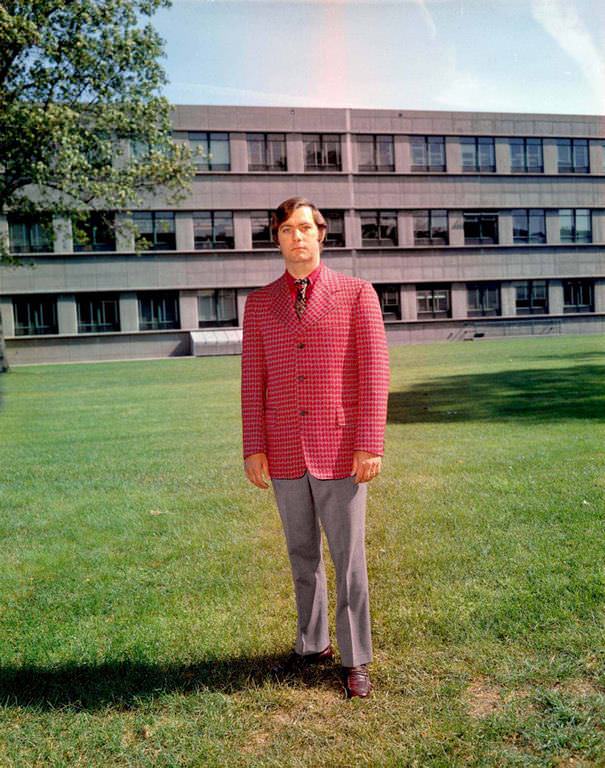
A man stands on a neatly cut lawn in front of a modern office-like building, dressed not in a uniform but in a bold red patterned sports jacket that looks ready for a night out. The title, “Kevlar body armor sports jacket, 1974,” hints at the quiet twist behind the fashion: protection woven into everyday clothing at a time when synthetic fibers were reshaping what textiles could do. The clean, sunlit setting and straightforward pose give the scene an almost showroom feel, as if the jacket is being presented as much as it’s being worn.
By the mid-1970s, Kevlar was emerging as a breakthrough material—lightweight, exceptionally strong, and quickly associated with protective gear. Pairing that kind of innovation with a tailored jacket speaks to a particular moment in invention culture, when new technologies were tested not only for performance but also for acceptability in daily life. Instead of bulky armor, the promise here is subtlety: a familiar silhouette that could offer added safety without announcing it.
Details like the crisp lapels, buttoned front, and coordinated tie underline how deliberately “normal” the garment is meant to appear, making this photograph a compelling entry in any collection about inventions and applied materials science. For readers interested in the history of body armor, Kevlar clothing, and 1970s technology, the image captures an early attempt to merge personal protection with mainstream style. It’s a reminder that innovation often succeeds—or fails—based on how seamlessly it can fit into ordinary routines.