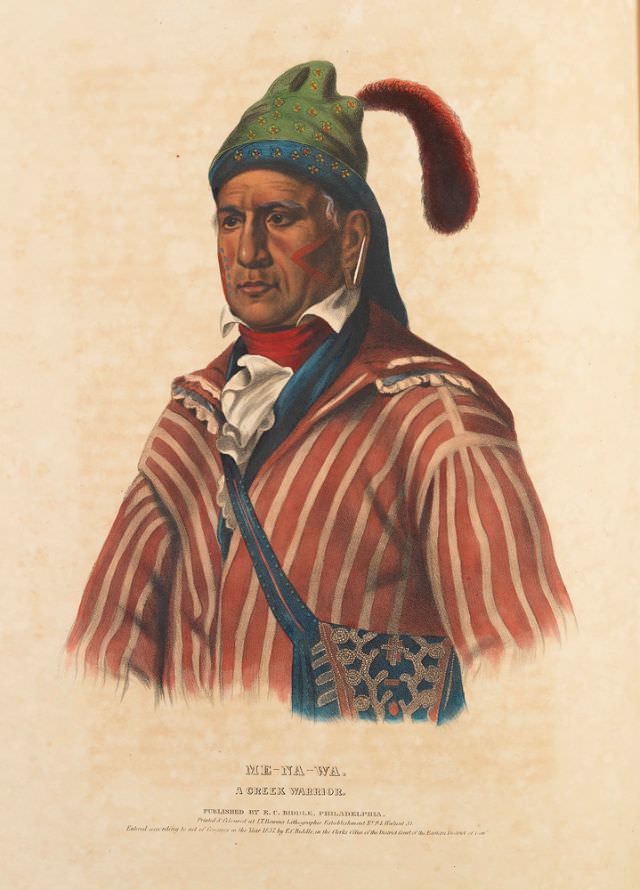
Me-Na-Wa appears here in a formal portrait that reads as both artwork and record, rendered with careful attention to dress, bearing, and the quiet authority of a warrior. The composition centers on his steady gaze and dignified posture, inviting the viewer to linger on the details that signal identity and status. Beneath the figure, the printed caption “ME-NA-WA. A CREEK WARRIOR.” anchors the image as a titled representation rather than an anonymous likeness.
Rich color and pattern do much of the storytelling: a striped outer garment falls in broad folds, while a blue strap and patterned sash add contrast and texture across the chest. Distinctive face paint marks the cheeks, and a single earring catches the light at the jawline, small elements that stand out against the soft, open background. The green headpiece, dotted with ornament and finished with a red plume, frames the portrait with ceremonial flair and emphasizes the subject’s rank and presence.
For readers searching for Creek history, Native American portrait art, or early printed depictions of Indigenous leaders, this piece offers a compelling entry point and a reminder of how nineteenth-century publishers shaped public understanding through images. The artist’s choices—pose, costume, and caption—suggest an intention to present Me-Na-Wa as a person of consequence, while also reflecting the era’s appetite for “types” and titles. Seen today, it works best when approached with curiosity and context, as a window into representation, memory, and the visual language used to describe a Creek warrior to distant audiences.