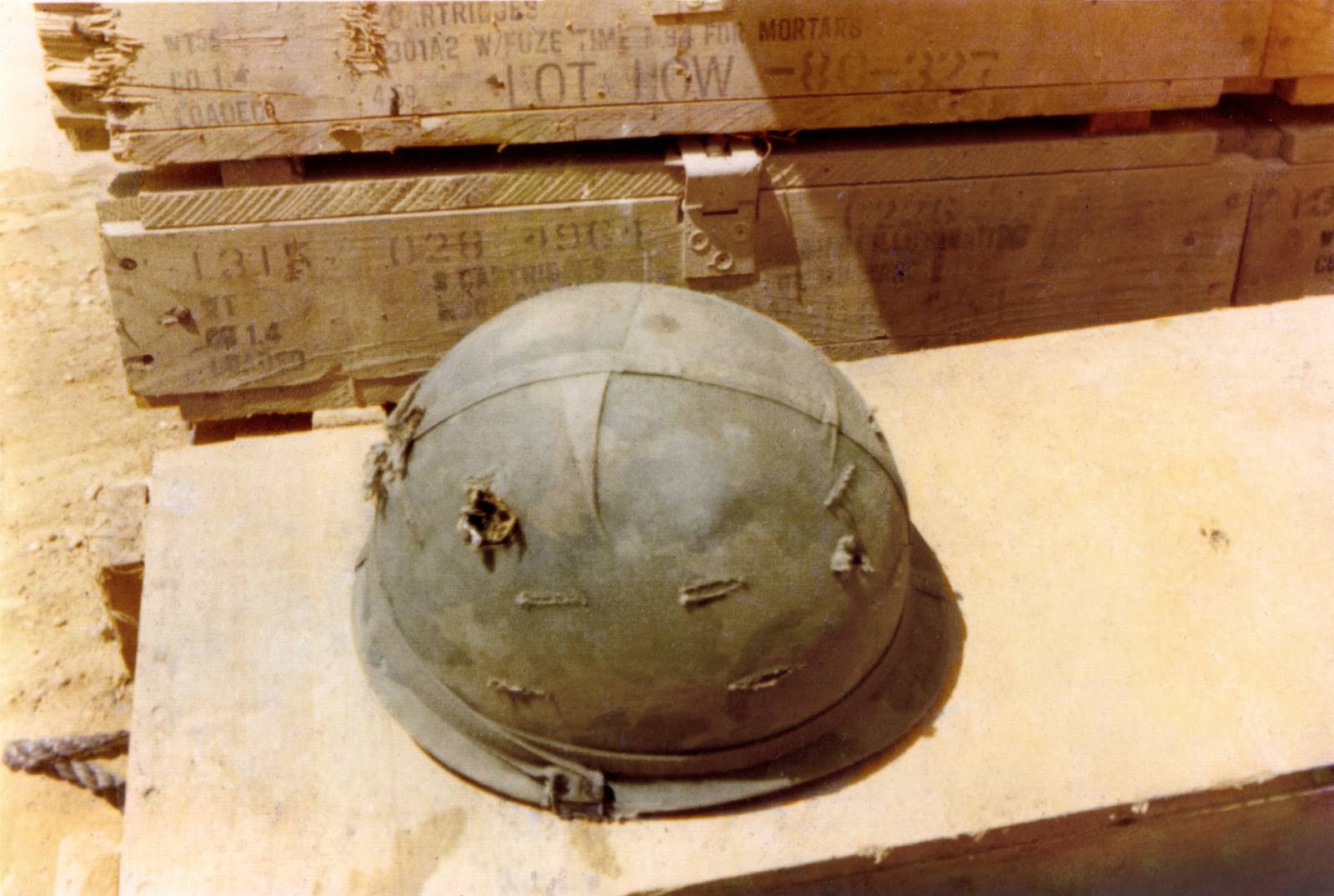
A dented steel helmet sits on a rough wooden surface, its faded paint and taped seams catching the harsh light of an outdoor fire base. Two punctures—ragged at the edges, darkened by grime—interrupt the smooth curve of the shell, turning standard-issue gear into a stark record of incoming fire. Set down like an exhibit rather than a uniform, it reads as a small, silent aftermath of a moment that didn’t make it into any official report.
Behind it, ammunition crates are stacked close, their stenciled lettering and battered boards hinting at the constant churn of supply and urgency typical of Vietnam War combat zones. The contrast is telling: the orderly geometry of boxes versus the chaotic violence implied by those holes. In Quang Ngai Province at Fire Base L.Z. Stinson, objects like this were never just objects—they were warnings, souvenirs, and evidence all at once.
What makes the title’s detail—“the photographer’s helmet”—so unsettling is the reminder that even the person documenting the war stood within its line of danger. The helmet becomes a stand-in for the thin margin between observation and casualty, between recording history and being swallowed by it. For readers searching Vietnam War photos, Fire Base L.Z. Stinson, or Quang Ngai Province imagery, this frame offers a visceral entry point: not grand strategy, but the intimate material cost of survival.