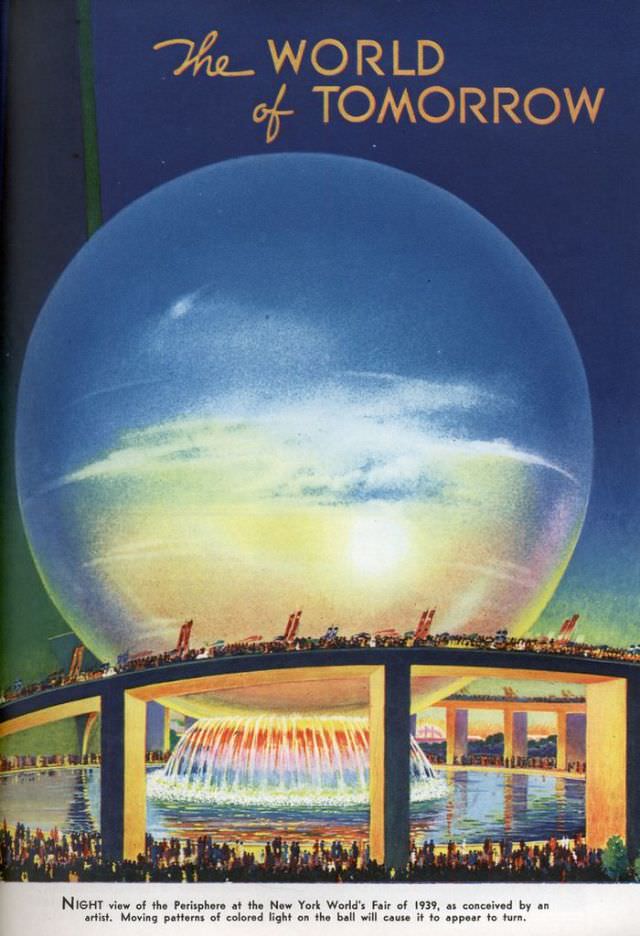
Gold lettering at the top proclaims “The World of Tomorrow,” setting a confident, forward-looking tone that defined the 1939 World’s Fair in New York. The poster centers on a gleaming, oversized sphere hovering above the fairgrounds, rendered in saturated blues and soft, luminous gradients that suggest both planet and beacon. Even without a street address or skyline, the composition reads instantly as a celebration of modern design and technological promise.
Beneath the glowing globe, crowds gather along a wide promenade and around a fountain whose colored light spills into the surrounding water, turning the scene into nighttime theater. The printed caption describes a “Night view of the Perisphere,” noting moving patterns of colored light meant to make the ball appear to turn—an early invitation to imagine motion, electricity, and spectacle as everyday experiences. Bridges, low structures, and reflective pools frame the centerpiece, creating a carefully staged vision of urban order and public wonder.
Posters like this served as more than advertisements; they were portable monuments to optimism, crafted to lure visitors into an engineered future of streamlined forms and illuminated spaces. For collectors of World’s Fair memorabilia, New York history enthusiasts, or anyone interested in vintage graphic art, the image distills the era’s faith in progress into a single, iconic symbol. As a piece of fair ephemera, it also reminds us how the language of futurism—glow, scale, crowds, and light—was used to sell the idea that tomorrow was already within reach.