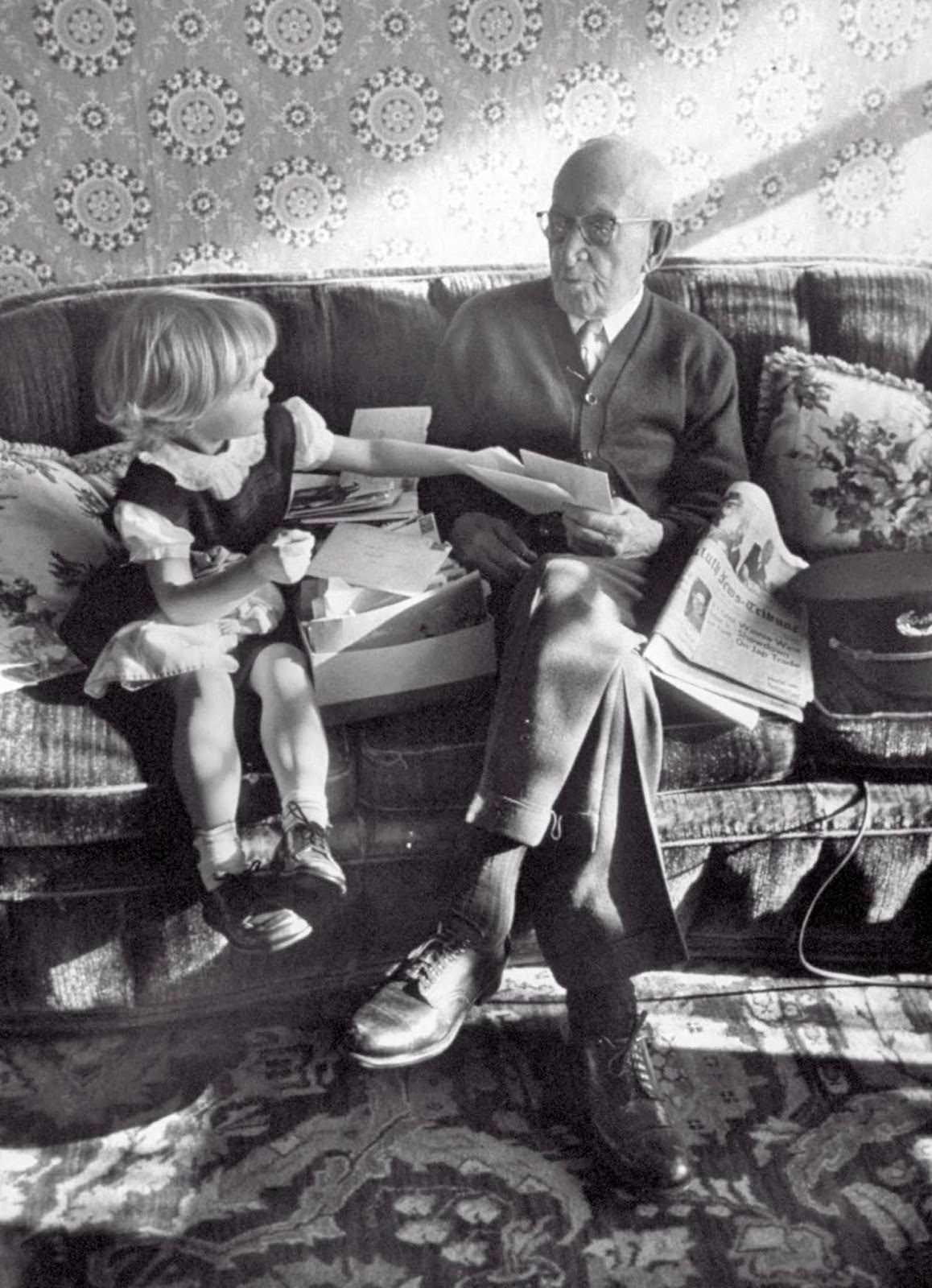
Sunlight falls across a well-worn living-room couch as Albert Woolson, said to be 107 years old and the last remaining Grand Army of the Republic (GAR) Civil War veteran, sits in quiet concentration with a small stack of letters in hand. Beside him, a little girl leans in to help, reaching toward the paper as if to pass him the next envelope or point out a familiar return address. The patterned wallpaper, embroidered cushions, and tidy rug frame the moment with mid-century domestic detail, grounding a national memory in an ordinary home.
What makes the scene linger is its gentleness: no parade, no uniform, just the steady ritual of sorting mail and the simple companionship of a child. Woolson’s glasses and cardigan suggest comfort and routine, while the box overflowing with correspondence hints at public attention—well-wishers, reporters, veterans’ groups, and curious admirers all eager to connect with a living link to the American Civil War. A folded newspaper rests nearby, reinforcing the sense that history is being followed in real time, even as it unfolds on a couch.
Set in 1954, the photograph compresses generations into a single frame, bridging the 19th-century conflict and the postwar American home front of the 1950s. For readers interested in Civil War history, the GAR, and the last survivors of Union veteran organizations, this candid portrait offers something rarer than spectacle: the everyday human afterlife of war, measured in letters, quiet conversations, and the patient help of a child. It’s a reminder that the past does not always arrive with drums and speeches—sometimes it arrives with today’s mail.