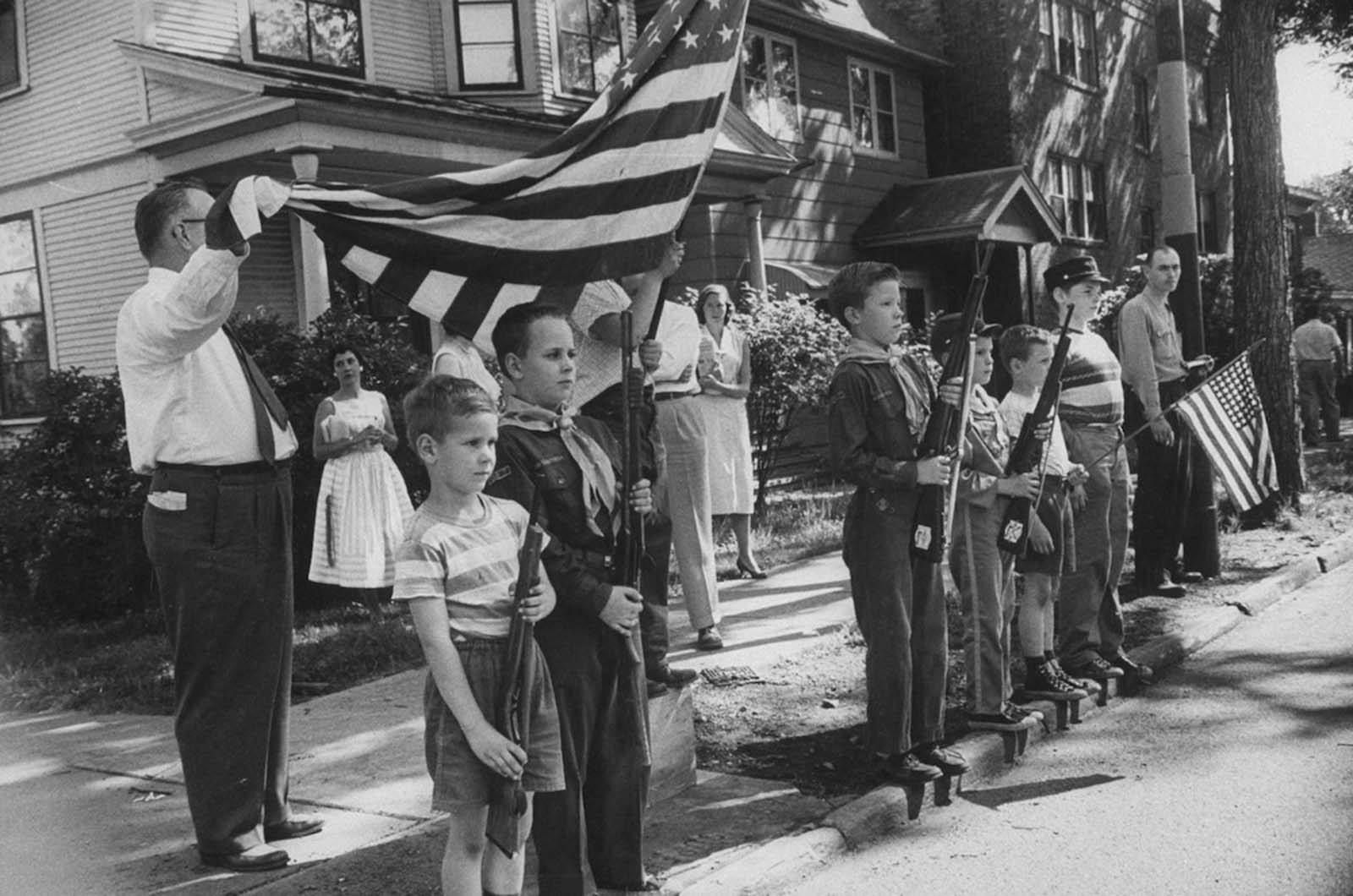
Along a quiet residential sidewalk, a line of boys stands rigidly at attention as a large American flag billows above them, its stripes stretched by a passing breeze. Several of the youths grip long rifles in the manner of a ceremonial honor guard, while adults behind them watch with folded hands and solemn faces. The setting—tree shade, front porches, and neighbors gathered close—gives the scene the intimate feel of a community pausing its daily rhythm to honor the dead.
In 1956, a Civil War veteran’s funeral was not merely a private farewell but a living bridge to the nation’s most defining conflict, and the title notes this man was the last member of the Grand Army of the Republic. That detail turns the moment into an end-of-an-era tableau: the fading of the last firsthand witness, and with it the closing chapter of an organization that once kept Union veteran memory visible through parades, reunions, and public ceremonies. The boys’ disciplined posture suggests how remembrance is taught—passed down in gestures, flags, and rituals that outlast those who originally fought.
For readers interested in Civil War history, veteran memorials, and mid-century American life, the photograph offers rich texture: uniforms and everyday clothing side by side, children practicing civic duty, and a neighborhood street transformed into a place of national mourning. The image also highlights how postwar commemoration evolved, shifting from veterans’ own voices to the communities and younger generations tasked with preserving the story. As a historical photo, it resonates as both a memorial scene and a snapshot of collective memory in the making.