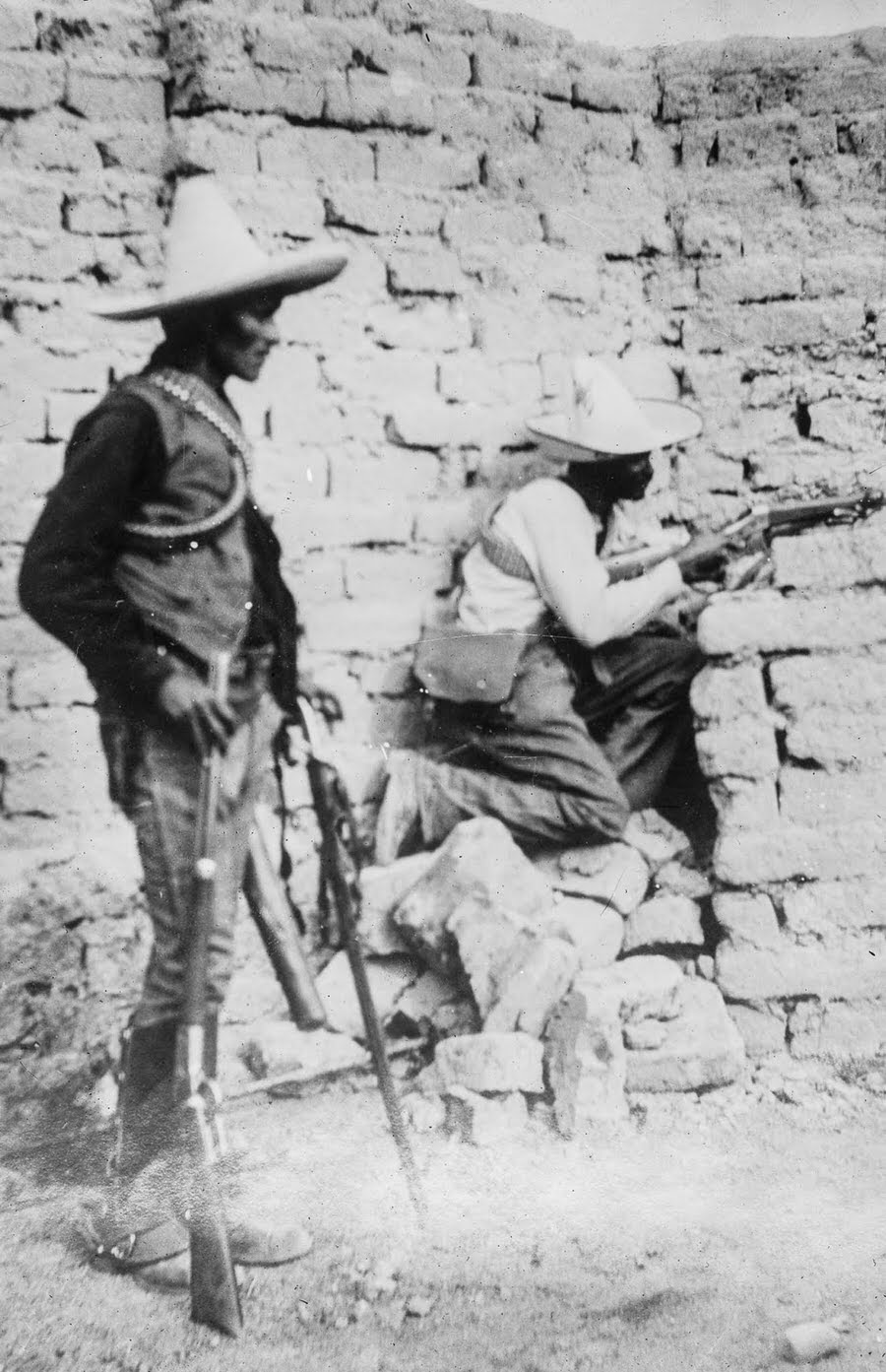
Against a rough adobe wall, two rebels in Ciudad Juarez take up a tense firing position, their wide-brimmed hats cutting a distinct silhouette against the sunlit masonry. One crouches behind a low pile of stones with a rifle aimed outward, while the other stands close by, weapon at the ready, watching the same unseen threat. The battered texture of the wall and scattered rubble suggest a neighborhood turned into an improvised fortification, where everyday structures become cover in an instant.
Details in the scene hint at the practical realities of civil wars: simple clothing layered with bandoliers, long guns built for distance, and the careful use of corners and height to command a line of sight. The composition pulls the viewer into a moment of waiting and calculation rather than spectacle, capturing how urban fighting often reduces grand political conflict to small, immediate choices—where to stand, when to move, how to stay alive. Even without identifying faces, the posture and spacing between the men conveys coordination and strain.
Ciudad Juarez, long shaped by borderland pressures and shifting authority, provides a fitting backdrop for an image like this, where loyalties and power could be contested street by street. For readers interested in Mexican history, revolution-era imagery, and the lived experience of insurgency, this photograph offers a stark window into battlefield improvisation and the human scale of conflict. It remains a resonant historical record of rebels under fire, framed by the crumbling geometry of a city at war.