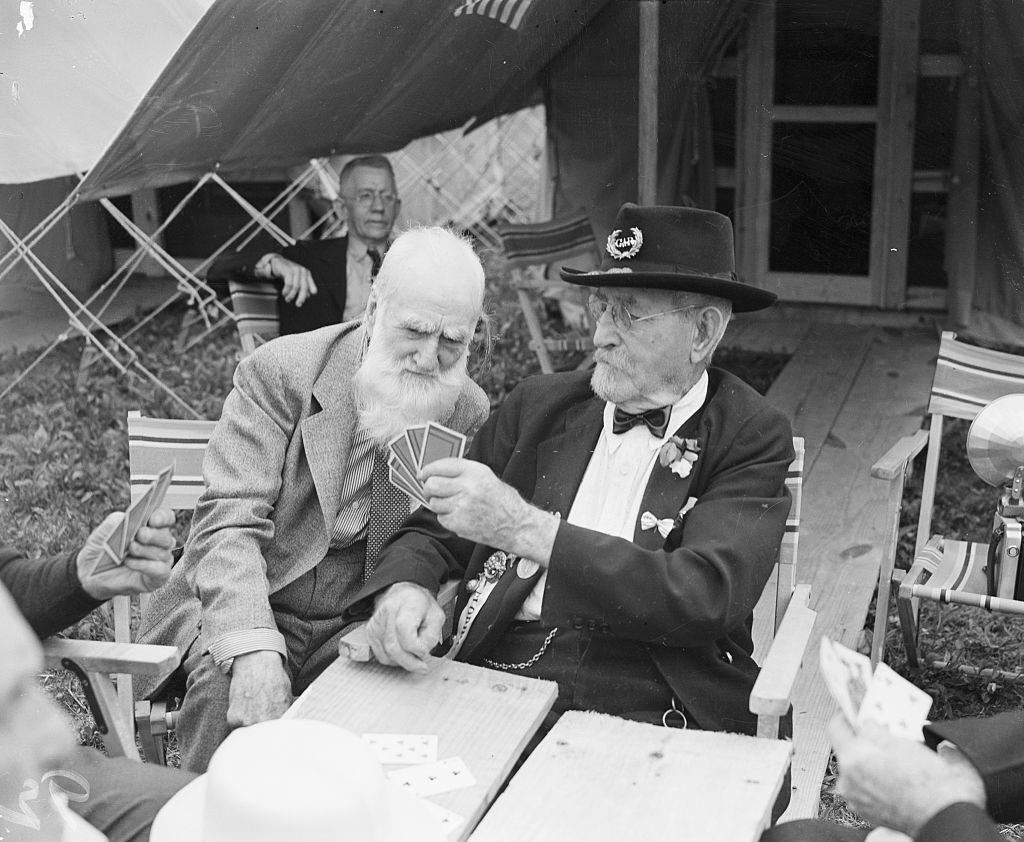
Under a canvas tent, a small circle of elderly Civil War veterans leans into the familiar rhythm of a card game, their attention fixed on the hands they hold and the moves still to come. One man studies his cards with a careful squint while another, dressed formally with a bow tie and a brimmed hat adorned with a badge, weighs his next play. Around them, the simple camp furnishings—folding chairs, wooden boards serving as a makeshift table, and a backdrop of tent poles and fabric—suggest a reunion setting where conversation and companionship mattered as much as the score.
Details in the scene quietly speak to age and endurance: long white beards, lined faces, and the measured posture of men who have lived through more than one era of American history. The veterans’ attire mixes everyday coats with commemorative touches, hinting at pride in service without turning the moment into ceremony. Even the partially seen players at the edges of the frame add to the intimacy, as if the viewer has stepped into a living room outdoors, where memories are exchanged between deals.
For readers searching Civil War history photographs, veteran reunion images, or everyday life after the war, this snapshot offers something rare—ordinary leisure layered over extraordinary experience. The card game becomes a bridge between the battlefield past and the quieter years that followed, when former soldiers gathered not to march, but to sit, talk, and pass the time with a well-worn deck. It’s a gentle reminder that history is preserved not only in monuments and uniforms, but also in shared games played beneath a tent’s shade.