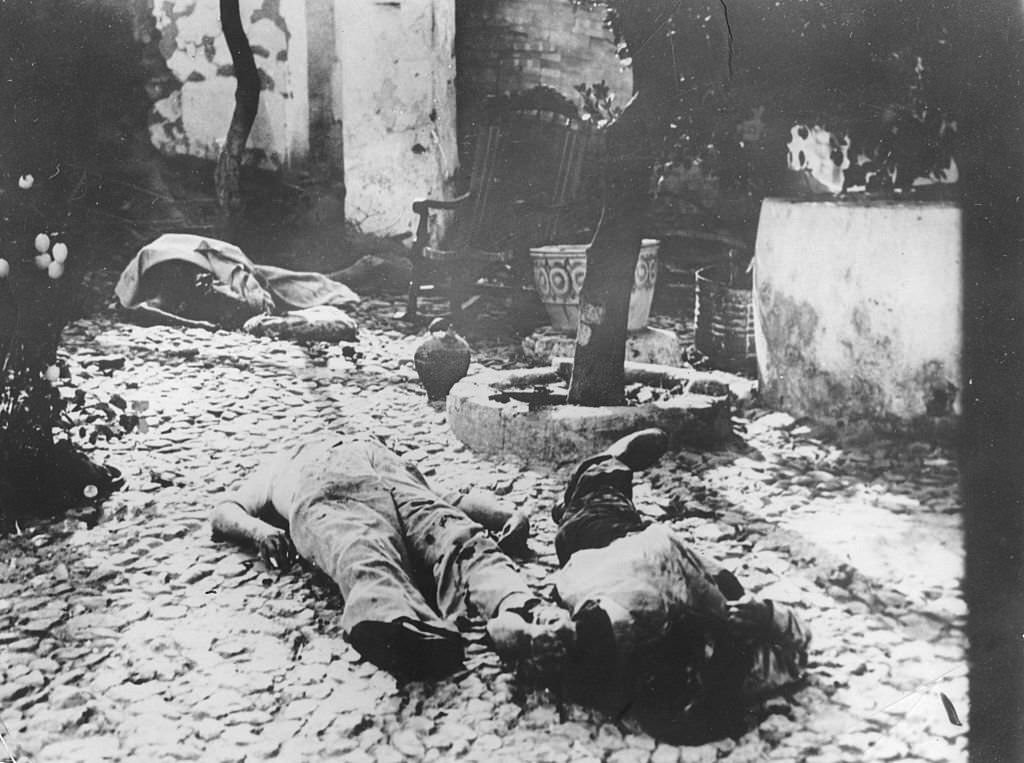
Silence hangs over a small courtyard in Salvochea, in the Province of Huelva, where bodies lie sprawled across uneven stone and dirt. A rough wall closes the space in, while a tree trunk rises from a low circular base, its shade falling across scattered debris. The scene is stark and unadorned, the kind of ordinary Andalusian setting that war abruptly turns into a place of irrevocable loss.
According to the post title, these are hostages shot during the Spanish Civil War, attributed here to Republican forces—an allegation that reflects the bitter, contested narratives that still surround wartime killings. The camera’s distance keeps faces indistinct, yet the details of clothing and posture make the violence unmistakably human and immediate. What reads at first as a simple documentary record becomes, on longer viewing, a visual ledger of terror used to punish, intimidate, and control communities.
Huelva and wider Andalucía were among the regions where the conflict quickly spilled beyond front lines into streets, farms, and backyards, leaving civilians exposed to reprisals and summary executions. Photographs like this one are difficult to share, but they remain crucial for understanding how the Spanish Civil War fractured local life and memory. For researchers and readers seeking context, the image invites careful comparison with archival sources on Salvochea, wartime detentions, and the shifting power struggles that shaped violence on both sides.