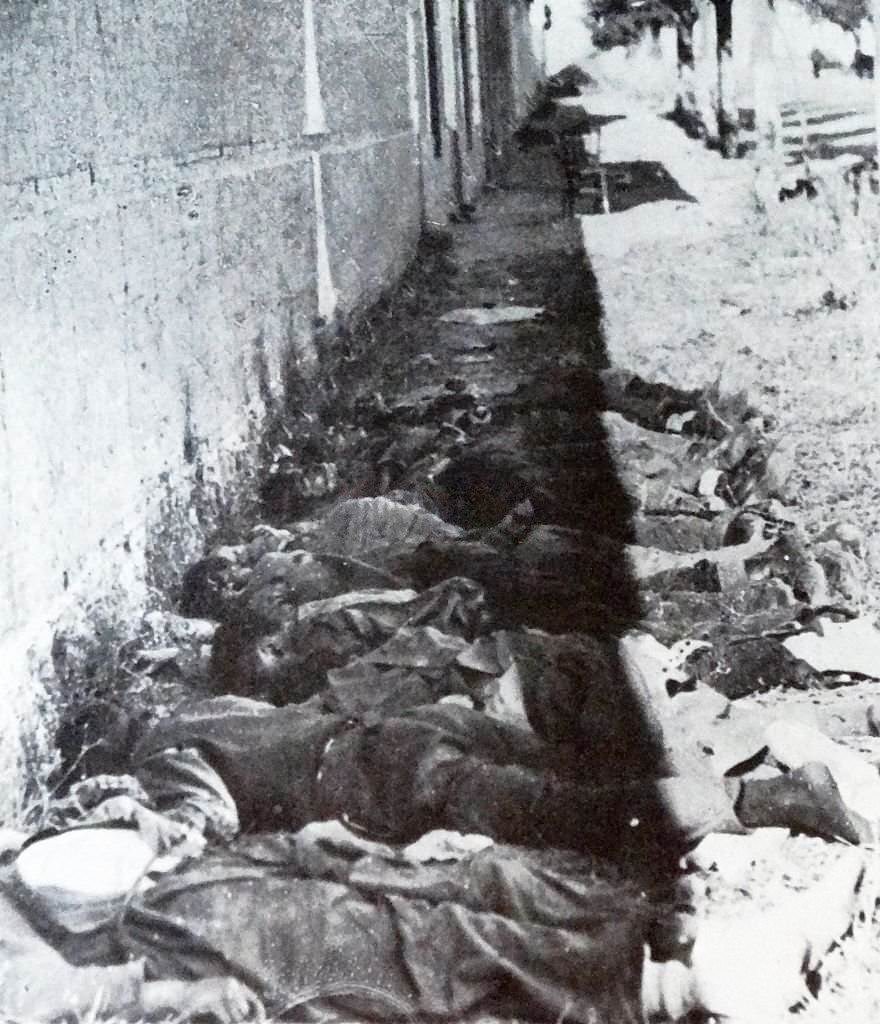
Along a rough wall, bodies lie in a grim row, their clothing and shoes still visible where they fell, while harsh sunlight and deep shadow divide the ground into stark bands. The setting feels like a street edge or courtyard boundary—ordinary masonry turned into a backdrop for extraordinary violence. Grain and blur in the photograph only heighten the sense of disorientation, as if the camera itself struggled to hold steady in the aftermath.
The title places this scene in Extremadura during the Spanish Civil War, a region that became synonymous with swift repression as Nationalist forces advanced. Estimates often cited for the number of Republican supporters executed there range between 6,600 and 12,000, a chilling figure that hints at how systematic such killings could be. In that context, the anonymous men in the frame stand for a broader terror: political identity reduced to a death sentence, families left without answers, and communities forced into silence.
What makes the image so difficult—and so historically important—is its plainness: no battlefield, no front line, just the consequences of power exercised at close range. For readers searching for Spanish Civil War history, Nationalist repression, or the fate of Republican supporters in Extremadura, this photograph confronts the reality behind statistics and slogans. It asks us to remember that the war’s story is also written in alleyways and along walls, where lives were ended and then hurriedly left for others to find.