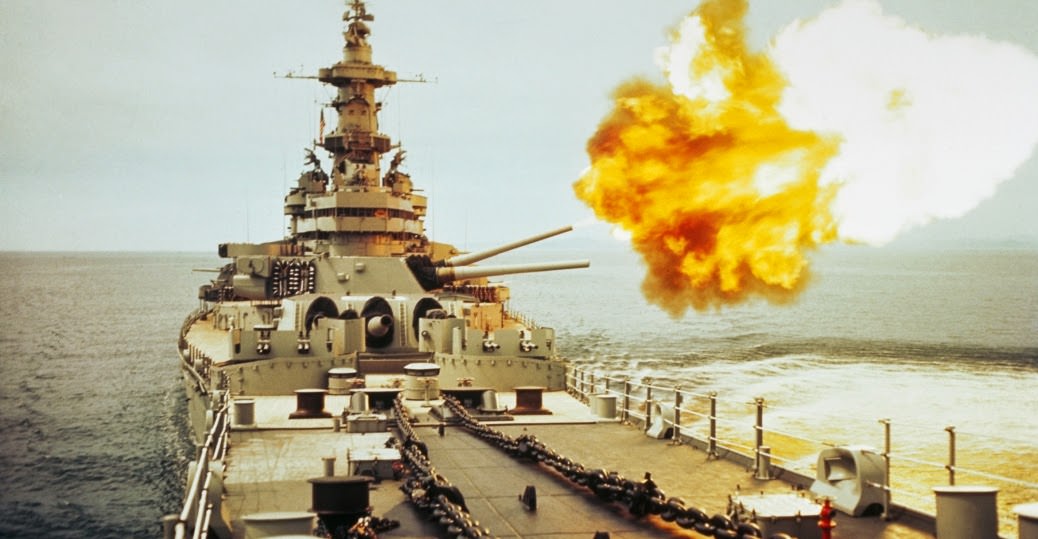
From the bows of the USS Missouri, the viewer is drawn down the long, steel deck toward the towering superstructure, where the ship’s massive 16-inch main batteries dominate the horizon. Chains, fittings, and railings frame the scene with utilitarian detail, while the open sea spreads out on both sides in a calm, flat expanse. The composition emphasizes scale and purpose: a battleship built for decisive firepower, seen from a perspective that makes its length and weight feel almost endless.
A brilliant orange-white muzzle blast erupts from the guns to starboard, a moment of violence suspended against the pale sky. Smoke and flame billow outward in a rounded, rolling cloud, and the water beside the hull shows a faint wake and churn that hints at speed and momentum. Even without hearing it, the photograph invites you to imagine the concussion, the vibration through metal decks, and the careful choreography required to operate the world of turrets, loaders, and spotting.
Set against the context of bombardment off North Korea, this image anchors a reader in the naval side of the Korean War, when big-gun ships returned to prominence for shore support and interdiction. It’s a striking record of the USS Missouri in action—part engineering marvel, part instrument of policy—captured at the instant its firepower leaves the barrel. For anyone searching naval history, Iowa-class battleship photos, or 16-inch gun imagery, this view offers an unforgettable, front-to-back glimpse of twentieth-century sea power at work.