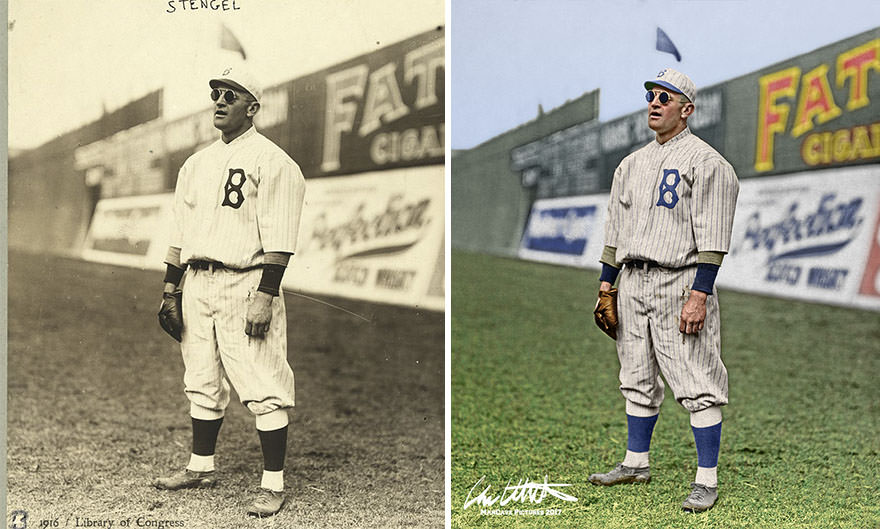
Casey Stengel stands in a Brooklyn uniform with the bold “B” on his chest, posed on the grass near the outfield wall as if caught between innings. The period details do most of the talking: a high-crowned cap, baggy pinstriped flannels, tall socks, and a well-worn glove hanging at his side. Behind him, early ballpark advertising stretches across the boards, hinting at the bustling commercial life that had already wrapped itself around America’s pastime by 1915.
Colorization brings new immediacy to the scene, separating fabric from shadow and turning the field into something you can almost smell—cut grass, dusty infield, sun on canvas and leather. The uniform’s stripes and trim read cleanly, while the glove and socks pop in a way the original monochrome can only suggest. Even the signage gains presence, transforming from faded lettering into the kind of bright, competitive billboard language that defined the era’s stadiums.
Set against the title “Casey Stengel, Brooklyn, 1915,” this photograph works as both a baseball history snapshot and a small window into how players were presented to the public in the early twentieth century—upright, composed, and unmistakably professional. It’s an ideal piece for readers searching for vintage baseball photos, Brooklyn baseball history, or a closer look at classic uniforms and ballpark culture. The side-by-side view of the original and the colorized version also invites a deeper appreciation of archival work, showing how modern restoration can refresh an old moment without erasing its age.