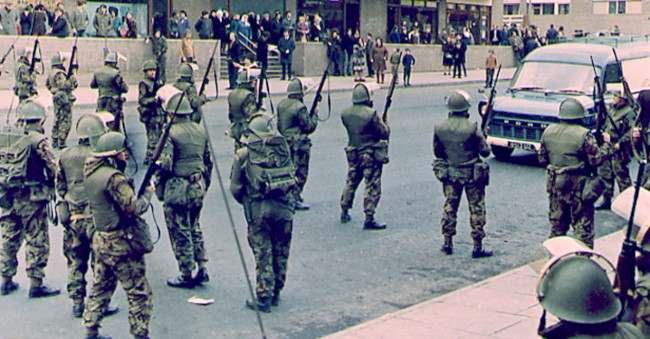
Along a wide Belfast roadway, British troops form a staggered line that cuts across the street, their helmets and rifles creating a hard visual rhythm against the open pavement. The stance is defensive rather than ceremonial—boots planted, backs turned toward the camera, attention fixed on the space ahead. In the background, small groups of civilians gather at a distance near the Catholic Unity flats, watching the scene unfold from the edge of the cordon.
Tension hangs in the ordinary details: parked and passing vehicles halted by armed presence, curb lines and building façades turned into an impromptu frontier. Camouflage uniforms blend into the city’s muted tones while the long barrels and sling straps draw the eye to the practical realities of street control. It’s a moment that speaks to the everyday mechanics of conflict—where a “main road” becomes a checkpoint and public life narrows to cautious observation.
Stories of civil strife in Northern Ireland often live in sweeping political narratives, but photographs like this bring the focus back to the street level, where authority, fear, and routine collide. The title’s mention of the Catholic Unity flats anchors the setting in a specific Belfast community, hinting at the contested spaces that shaped local experience. For readers searching British troops Belfast, Northern Ireland conflict imagery, or The Troubles-era street scenes, this photo offers a stark, grounded glimpse of a city under pressure.