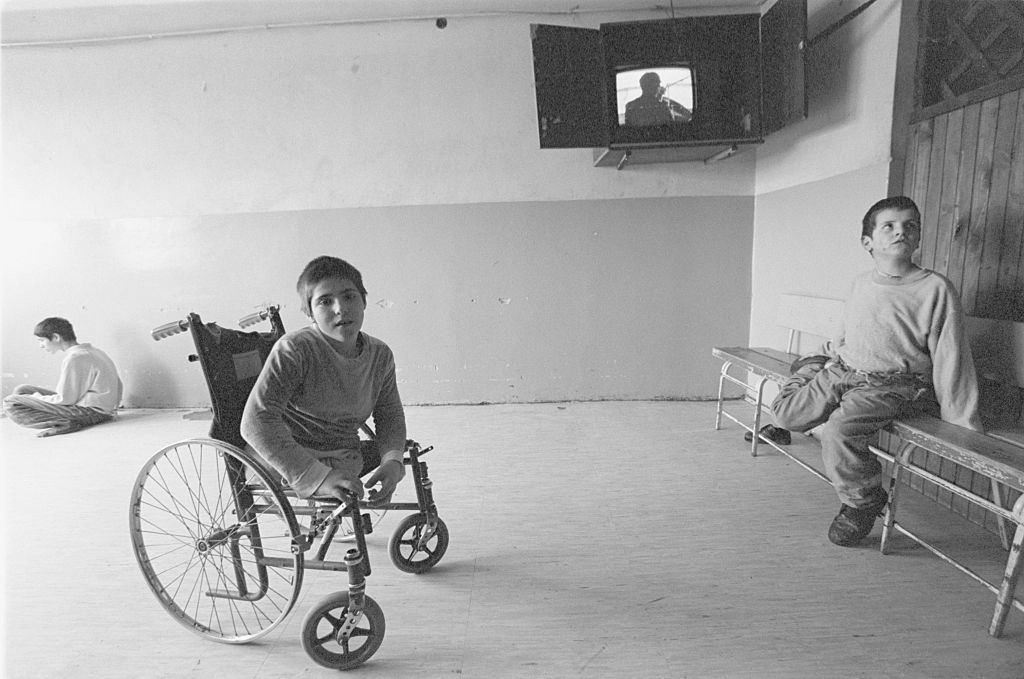
High on the wall, a small television set glows like a distant window, while the room below stretches out in spare, institutional quiet. Benches line the right side, a plain cot sits nearby, and the scuffed floor emphasizes how much of the space is meant to be watched and waited through rather than lived in. In the center, a young patient in a wheelchair faces the camera, his posture and expression suggesting the uneasy visibility of clinical life.
Across the frame, two other figures inhabit the margins—one seated on the floor at left, another perched on a bench to the right—each turned slightly away, as if drawn by the TV’s flicker or by thoughts that don’t require an audience. The television room in the psychiatric clinic appears designed for supervision as much as recreation: open sightlines, minimal furnishings, and the entertainment placed out of reach. Even the set’s high mounting hints at control, a shared program delivered from above in a space where privacy is scarce.
As a historical photo, it invites a careful reading of everyday routines inside psychiatric institutions, where leisure and treatment often overlapped and where communal spaces carried their own rules. The title’s focus on a “television room” underscores how mass media entered clinical settings, offering distraction, structure, and a fragile sense of normalcy. For readers exploring social history, institutional architecture, or the lived experience of mental health care, this image offers a stark, human-scale glimpse into that controlled interior world.