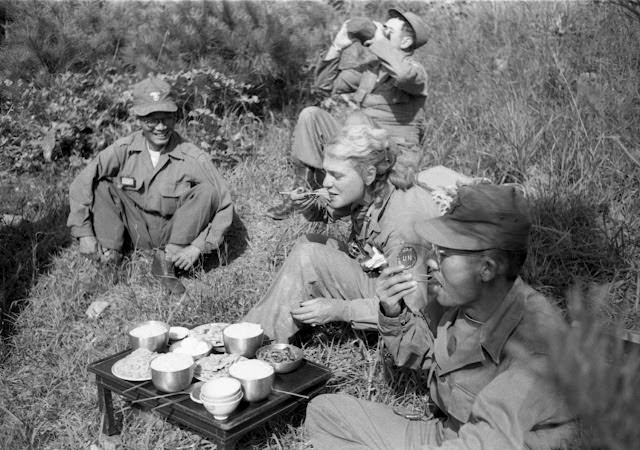
Midday light falls across a grassy hillside where a small group of South Korean troops pauses for a simple, communal meal, their rifles out of frame but the fatigue of field life still present in their posture. At the center sits LIFE magazine photographer Margaret Bourke-White, sleeves rolled and camera gear resting against her chest, leaning in as if to listen between bites. Metal bowls and lidded containers crowd a low tray, a practical spread that hints at routine and resilience amid a larger conflict.
One soldier grins toward the lens, another tilts his head back to drink, and the easy, unguarded gestures make the moment feel briefly domestic despite the uniforms. Bourke-White’s presence is more than observational; she is accepted into the circle, sharing both food and proximity in a way that collapses the distance between correspondent and subject. The composition turns a battlefield interlude into a portrait of companionship, showing how war is often lived in the ordinary minutes between danger.
For readers searching Korean War photography, LIFE magazine archives, or Margaret Bourke-White’s work in 1952, this scene offers a grounded reminder of what photojournalism could accomplish: not just evidence, but intimacy. The quiet contrast—laughter and lunch against the implied strain of combat—helps explain why her images endure in discussions of wartime reportage. It’s a modest picnic on the grass, yet it carries the weight of history in every bowl, glance, and pause.