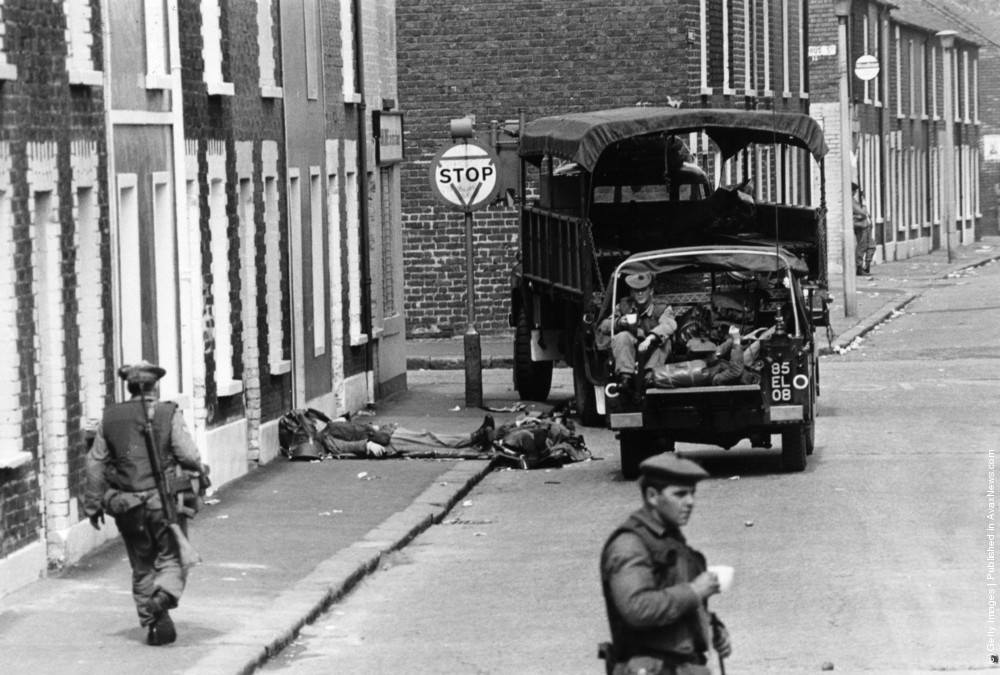
Along a tight row of brick terraces on the Falls Road in Belfast, armed British soldiers move through a street emptied of ordinary life, their presence turning a familiar neighbourhood into a controlled zone. A “STOP” sign hangs at the corner like an ironic echo of the authority now being enforced, while military vehicles sit squarely in the roadway, blocking movement and setting the tone of the curfew. The quiet here is not peaceful; it is imposed, measured out in checkpoints and patrols.
Details in the frame hint at the rhythms of an operation rather than a passing patrol: troops positioned at different distances, one figure crossing the foreground, others clustered around the vehicles, kit and supplies visible in the open back. The architecture—uniform facades, narrow pavement, and close-set doors—makes the scene feel compressed, as if the street itself funnels tension toward the barricaded end. Even without visible crowds, the photograph conveys how curfew policing reshaped public space during the early Troubles.
For readers tracing Belfast history and the wider conflict in Northern Ireland, this July 1970 moment on the Falls Road stands as a stark example of how civil unrest translated into daily restrictions. Curfews were not abstract policy; they were lived in streets like this one, where mobility, commerce, and community life could be halted by force. Seen today, the image remains a powerful visual record of military intervention, urban control, and the fragile line between security measures and siege-like conditions.