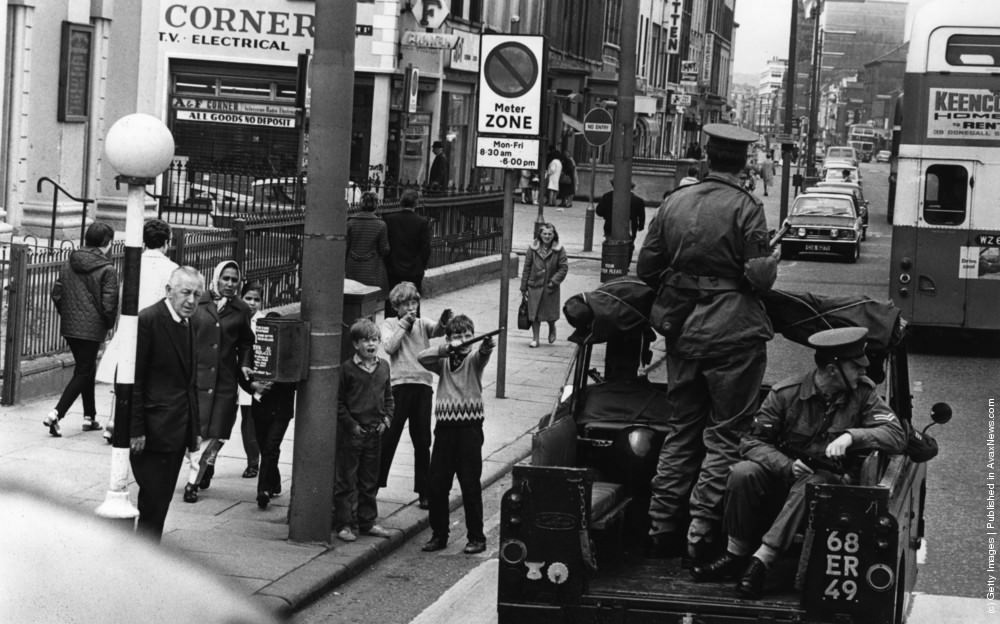
On a busy Belfast street in July 1970, everyday routines continue in the shadow of a security presence, with pedestrians moving past shopfronts, railings, and street signs while an Army patrol occupies the curb. The patrol sits and stands in an open vehicle, kit and uniforms sharply outlined against the pavement, as traffic and a large bus press on in the background. Ordinary city details—parking notices, storefront lettering, and the rhythm of footfall—anchor the scene firmly in public space rather than a battlefield.
In the midground, children turn the moment into a performance, clustering together and directing their gestures toward the soldiers. Their stance reads as defiant play: a small crowd testing boundaries, daring attention, and making a spectacle of authority passing through their neighborhood. The contrast is striking—youthful bodies animated with bravado set against the still, watchful posture of armed men.
The photograph speaks to the texture of the early Troubles, when contested streets became stages where civilians and security forces faced one another in brief, charged encounters. It is less about a single incident than about atmosphere: the normalization of patrols, the proximity of tension to daily errands, and the way conflict seeps into childhood. For readers searching Belfast 1970, British Army patrol images, or everyday life during civil unrest, this frame offers a stark, street-level perspective on how quickly a city’s ordinary scenes can become political theatre.