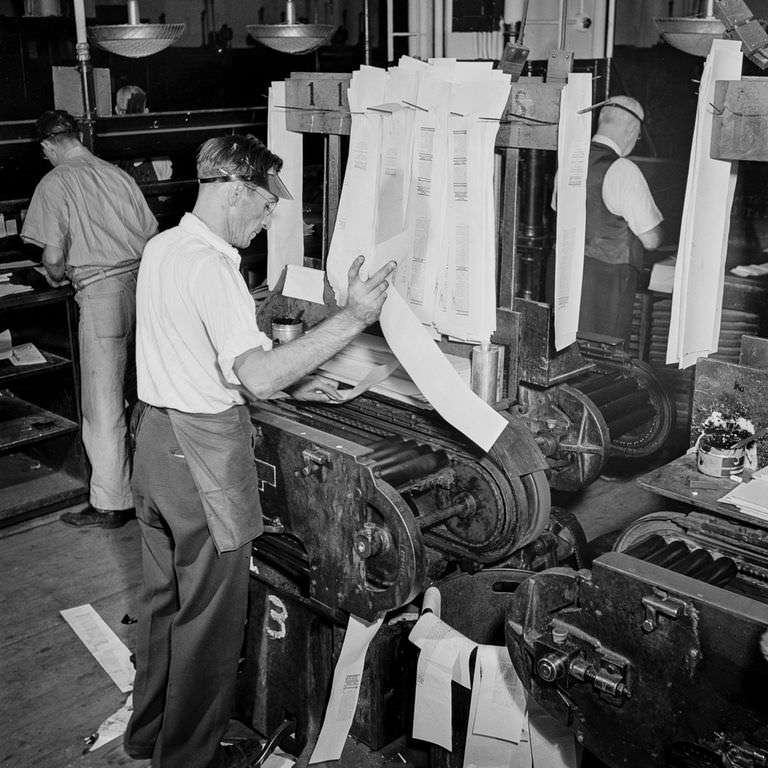
Ink, paper, and pressure meet at the proof press, where long strips of freshly printed text spill forward in a steady rhythm. In the foreground, a worker in a visor and apron guides the sheets with practiced hands, reading as he handles them, while the machine’s rollers and gears dominate the shop floor. The scene is industrial yet intimate: proof after proof emerges as a tangible draft of tomorrow’s publication, meant to be handled, marked, and scrutinized.
Proofs were the newsroom’s checkpoint, turning the invisible labor of typesetting into something editors could correct before mass printing. These pages weren’t the final product; they were working documents destined for make-up editors who would hunt for errors, adjust spacing, and ensure columns and headlines would land exactly where they belonged. The photo highlights an often-overlooked stage in printing history, when precision depended on both mechanical reliability and sharp-eyed human judgment.
For readers interested in inventions and the evolution of publishing technology, this image offers a grounded look at how newspapers and printed materials were refined behind the scenes. The proof press stands as a bridge between composition and the full press run, enabling faster corrections and smoother production workflows. It’s a reminder that “getting it right” was once a physical process—paper trails, ink smudges, and all—before revisions became a matter of clicks and screens.