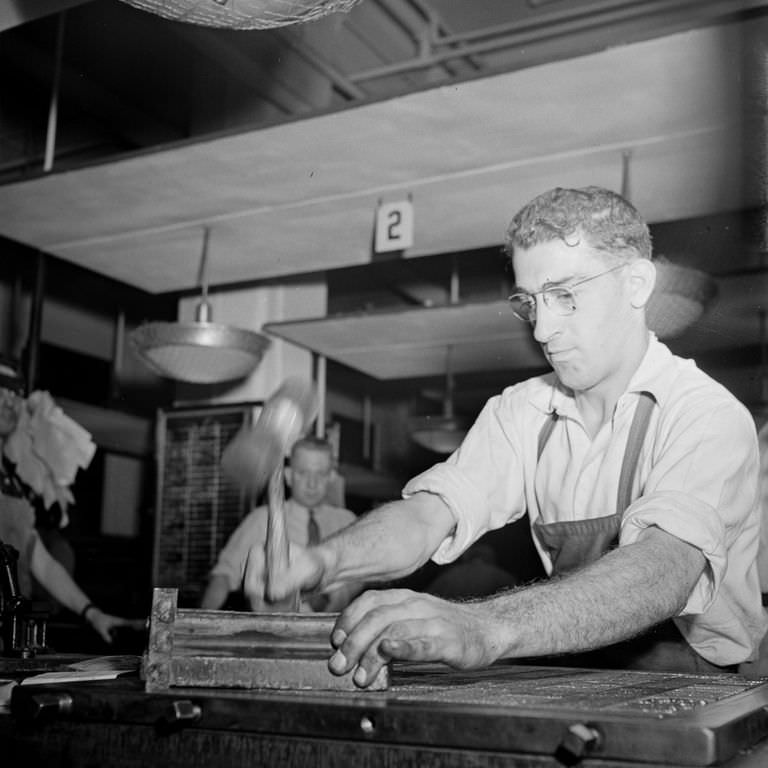
Under bright shop lights, a focused printer leans over a completed page, mallet in hand, as he “hammers down” the type to lock it firmly into place. The scene is all concentration and cadence: rolled-up sleeves, an apron for protection, and the steady grip needed to keep a heavy form true and square. Behind him, other workers and hanging lamps hint at a busy pressroom where precision mattered as much as speed.
The title points to a crucial moment in letterpress printing, when movable type—already arranged into words and lines—had to be tightened so it wouldn’t shift during the press run. A few millimeters of movement could blur text, warp spacing, or ruin an entire batch, so the final securing of the forme was part craft, part engineering. Inventions weren’t only new machines; they were also the disciplined techniques that made mass communication reliable.
Seen today, the photograph reads like a portrait of industrial ingenuity, where hands-on skill turns metal letters into readable pages. The numbered sign overhead and the orderly workstations suggest a structured production environment, yet the decisive action at the foreground reminds us how much depended on human judgment. For anyone interested in printing history, typography, or the evolution of publishing, this image offers a vivid window into the labor that made everyday reading possible.