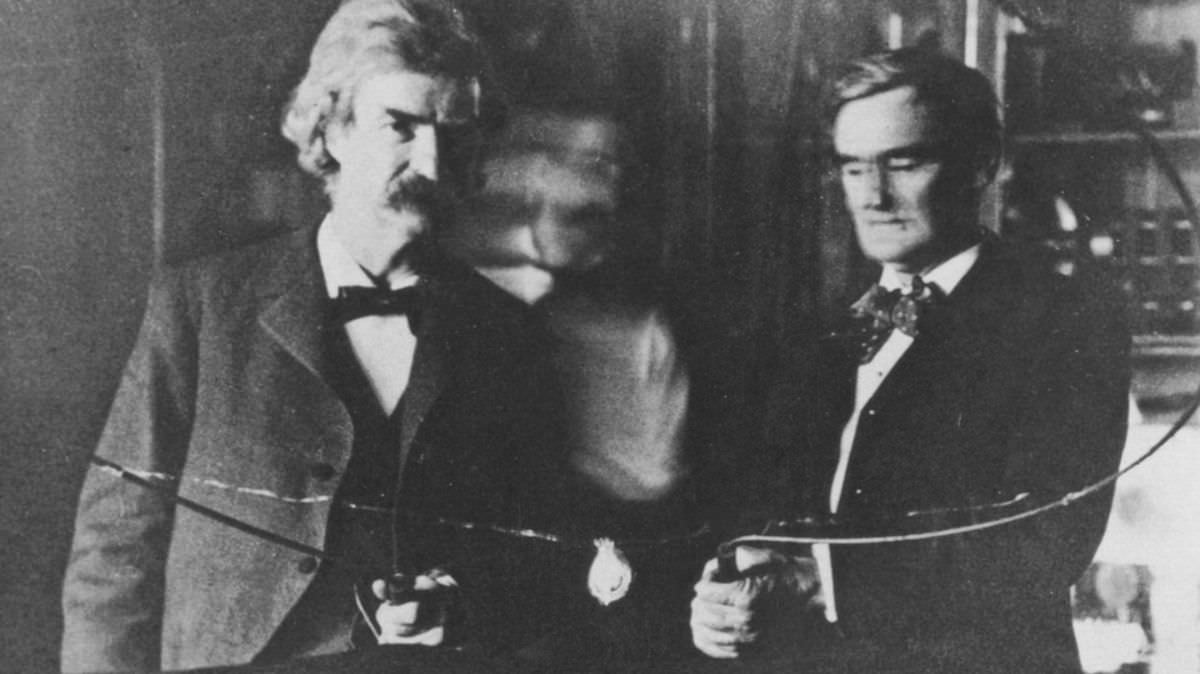
Between the stern gaze on the left and the composed figure on the right, a blurred presence at center hints at motion—Nikola Tesla caught mid-demonstration as electricity becomes performance. The title identifies the onlookers as writer Samuel Clemens, better known as Mark Twain, and actor Joseph Jefferson, placing this moment in 1894 when the laboratory could feel as thrilling as a stage. Coats, bow ties, and the dim industrial backdrop frame a scene where celebrity, curiosity, and invention collide.
What draws the eye is the thin line of apparatus stretching across the men, suggesting wires or a conducting element used in an electrical experiment. Tesla’s indistinct outline reads like a ghost in the exposure, a visual reminder that early photography struggled to freeze fast action—especially in low light. The result is fitting: an inventor associated with invisible forces rendered nearly intangible while his guests remain sharply etched, watching the spectacle of modern power.
For readers interested in Nikola Tesla history, Mark Twain in the laboratory, or the culture of inventions in the late 19th century, this image offers an unusually intimate crossroad of science and the arts. It’s not just a portrait of famous men; it’s a snapshot of how new technology was introduced to the public—through demonstrations, conversation, and a sense of wonder. Seen today, the photograph captures a pivotal mood of the era: electricity emerging from theory into everyday fascination, with Tesla at the center of the storm.