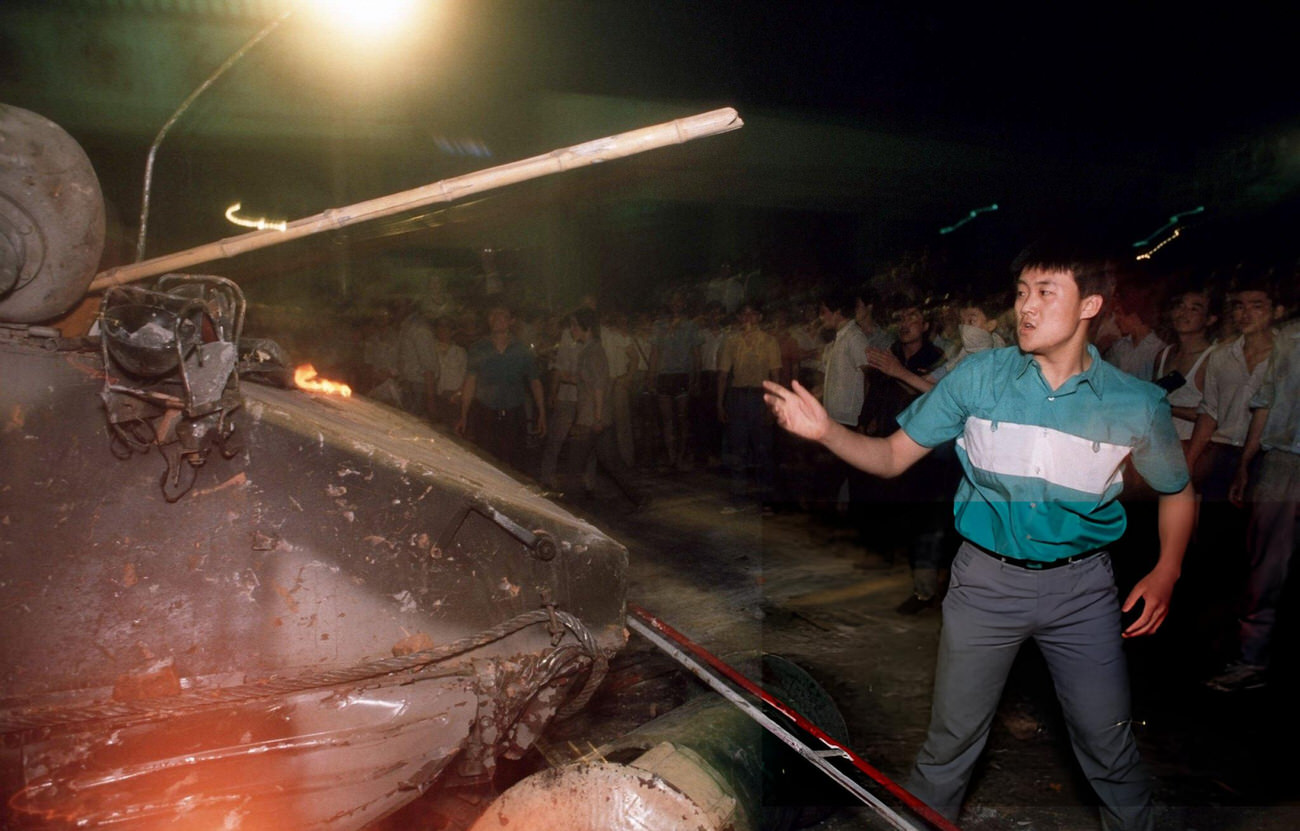
Under harsh streetlights and thickening smoke, a lone pro-democracy demonstrator hurls a long wooden pole toward a burning armored personnel carrier, turning a split second of motion into a lasting symbol of defiance. The vehicle’s scorched metal, tangled fittings, and small tongues of flame suggest the immediate aftermath of a violent confrontation, while the thrower’s tense posture and focused gaze convey both urgency and peril. In the background, a dense crowd presses in, faces half-lit and watchful, as if deciding whether to surge forward or step back.
What makes the scene so arresting is the collision of scale and power: civilian improvisation against military hardware, a simple pole against armor and fire. The photo’s night setting amplifies the drama, with reflections on the pavement and glare from overhead lights framing the APC’s hulking silhouette. Even without a clear banner or placard visible, the title anchors the moment in 1989’s wave of pro-democracy unrest, when public squares and streets became contested stages for demands that governments struggled to contain.
For readers searching civil wars photography, protest history, or 1989 political upheaval, this image offers a visceral entry point into how quickly demonstrations can tip into street battles. It invites questions about what led to the burning vehicle, how the crowd’s mood shifted, and what consequences followed for ordinary people caught between authority and resistance. Seen today, the photograph stands not only as documentation of disorder, but as a reminder of how courage, anger, fear, and hope can all occupy the same frame.