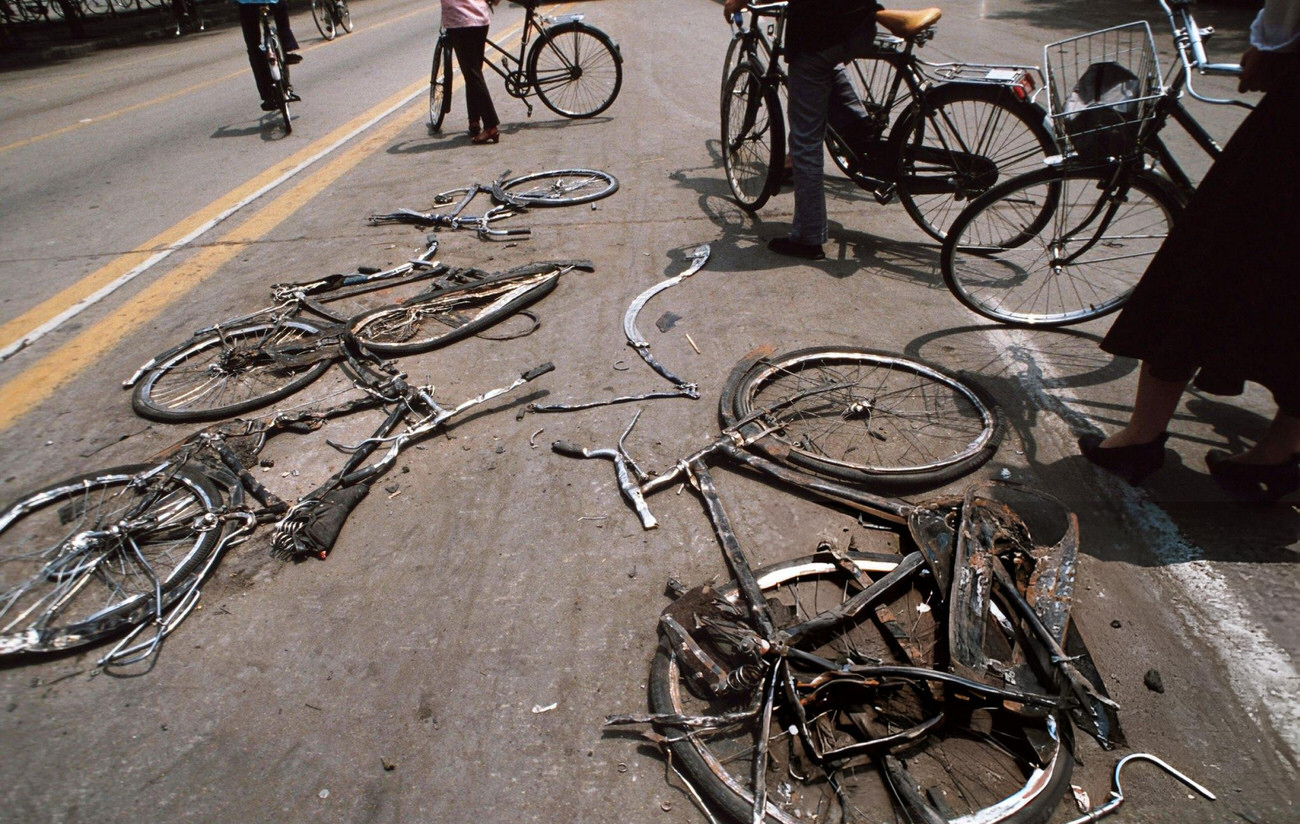
Scattered across the asphalt, twisted frames and buckled wheels lie in stark contrast to the upright bicycles still held by onlookers at the edge of the road. The camera lingers on the aftermath rather than the clash itself: metal spokes splayed like broken ribs, handlebars bent into unnatural angles, and scraps of debris tracing a rough line along the street markings. A few cyclists pause mid-journey, their posture cautious and still, as if trying to read the story written in the wreckage.
According to the title, these bicycles were flattened by Chinese army tanks in 1989, turning everyday transport into an emblem of force meeting civilian life. Bicycles, so often associated with work commutes and ordinary routine, become here a quiet measure of what heavy machinery can do when it moves through a city without regard for what’s in its path. The absence of visible tanks in the frame only heightens the tension—what remains is the evidence, and the lingering presence is felt in the crowd’s hesitant distance.
For readers searching for historical photos from 1989, images like this offer a ground-level view of political violence and its imprint on public space. The scene suggests a moment after upheaval, when people begin to return to the streets but cannot ignore what has been left behind. In a single roadway strewn with crushed bicycles, the photograph compresses fear, disruption, and memory into an everyday setting—an enduring reminder of how quickly normal life can be reshaped by state power.