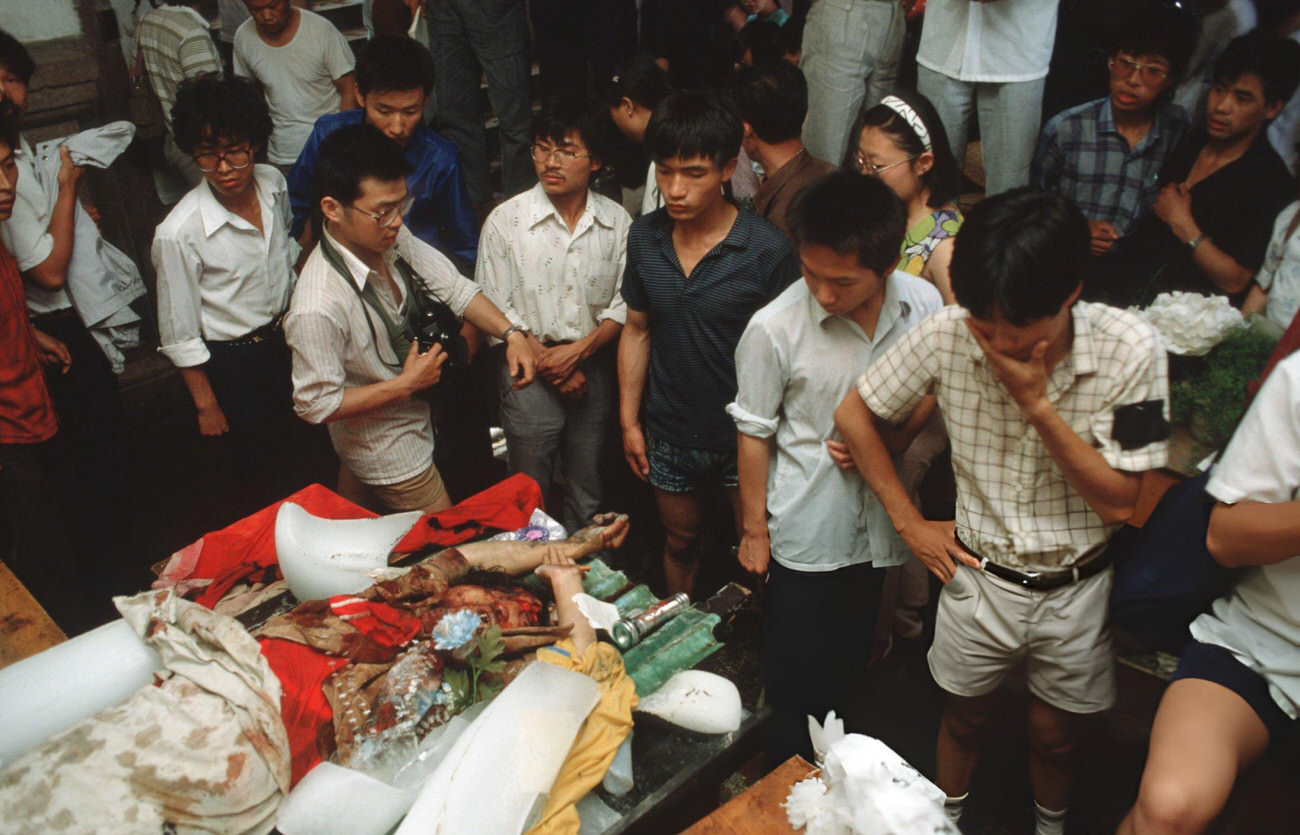
A tight ring of onlookers crowds around a makeshift table, faces drawn with fatigue and disbelief as they lean in to confirm what rumor has already told them. The dead protestor lies amid hastily gathered coverings and scattered items, the improvised setting underscoring how quickly public space can be turned into a temporary morgue. In the front, one man lifts a hand to his mouth as if to steady himself, while another grips a camera, caught between documenting and mourning.
Taken in 1989, the photograph speaks to the grim logistics that follow political violence: bodies identified in crowded rooms, evidence preserved by whoever has the means, and grief forced into public view. Clothing and everyday objects sit beside the remains, details that tether this scene to ordinary life and make the loss harder to keep abstract. The crowd’s posture—bent shoulders, lowered eyes, averted gazes—records a community confronting the cost of protest in real time.
For readers interested in civil wars and the broader history of unrest, images like this offer more than tragedy; they reveal how societies process shock, assign meaning, and search for accountability. The temporary morgue becomes a crossroads where private sorrow meets public memory, and where witness turns into an act of resistance or survival. Even without a named place in the frame, the atmosphere is unmistakable: a moment when history stops being headline and becomes a body, a room, and the silence of those gathered around it.