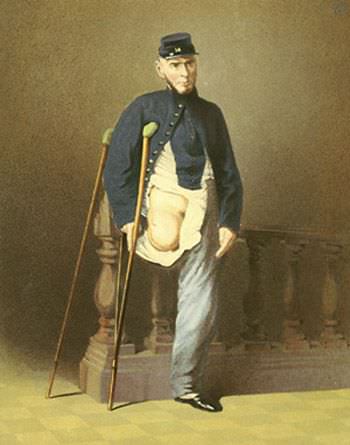
Leaning on a pair of wooden crutches, Private Lewis Francis stands in his Union uniform with a weary steadiness that feels hard-won. The studio setting is plain, yet his posture and the careful arrangement of gear beside him turn the portrait into a quiet statement about survival. Details like the cap, dark jacket, and light trousers help anchor the image in the Civil War era, while the crutches make the cost of service impossible to ignore.
According to the title, Francis served in Company I of the 14th New York Militia and was wounded at the First Battle of Bull Run on July 21, 1861, first by a bayonet thrust to the knee and then by at least fourteen additional stabs. Knowing that context, the bandaged or braced leg and the reliance on crutches read not as props but as evidence of battlefield trauma carried into civilian spaces. It’s the kind of wartime portrait that bridges front-line violence and the long, uneven process of recovery.
For readers exploring Civil War history, Union militia units, or the human aftermath of Bull Run, this photograph offers a starkly personal doorway into the conflict. It also foreshadows the broader story hinted in the title: Francis lived for years after his injuries, dying on May 31, 1874, a reminder that wounds could shape an entire lifetime long after the guns fell silent. As a historical image for a WordPress post, it pairs well with discussion of early-war fighting, medical care, and the enduring scars borne by individual soldiers.