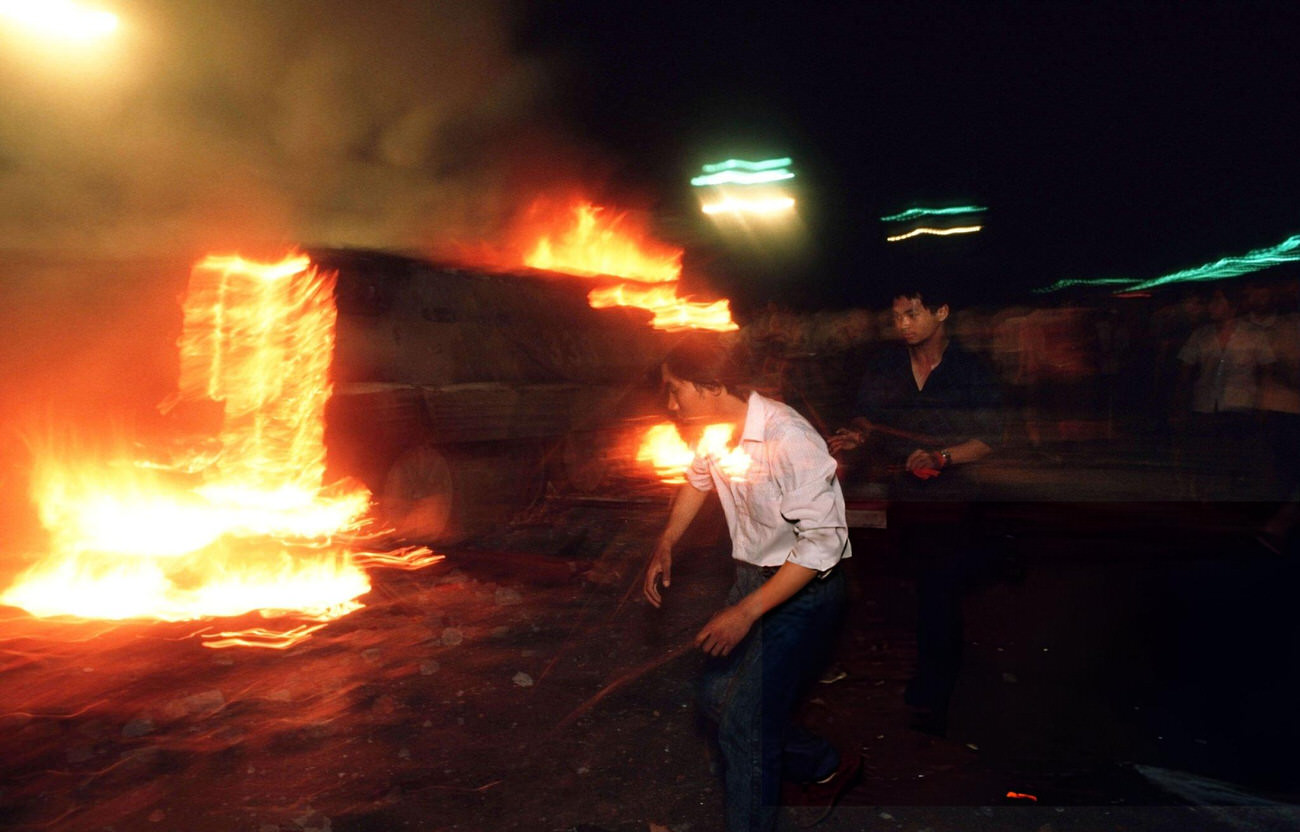
Firelight tears through the night on Changan Avenue as a military vehicle burns, turning the street into a corridor of heat, smoke, and panic. The camera’s blur and streaking neon suggest sudden motion and confusion, with figures rushing past the wreck as flames lick along the metal frame. It’s an urban battlefield moment—bright, loud, and unstable—where the boundary between protest and crackdown collapses in real time.
At the edge of the blaze, young demonstrators appear mid-stride, their faces tense and half-lit by the orange glow. The scene reads as both documentary and visceral memory: scattered debris on the asphalt, a looming plume of smoke, and bodies moving instinctively away from danger. Even without visible slogans, the title anchors the meaning—pro-democracy demonstrators fleeing—and the photograph becomes a snapshot of fear, resolve, and disorientation in 1989 China.
Changan Avenue is more than a road here; it functions as a symbolic stage where state power, public dissent, and the cost of confrontation meet. For readers searching the history of the 1989 protests, the Tiananmen Square era, and the wider story of civil conflict and repression, this image offers a stark, immediate entry point. It reminds us how quickly public spaces can transform, and how a single burning vehicle can illuminate an entire political moment.