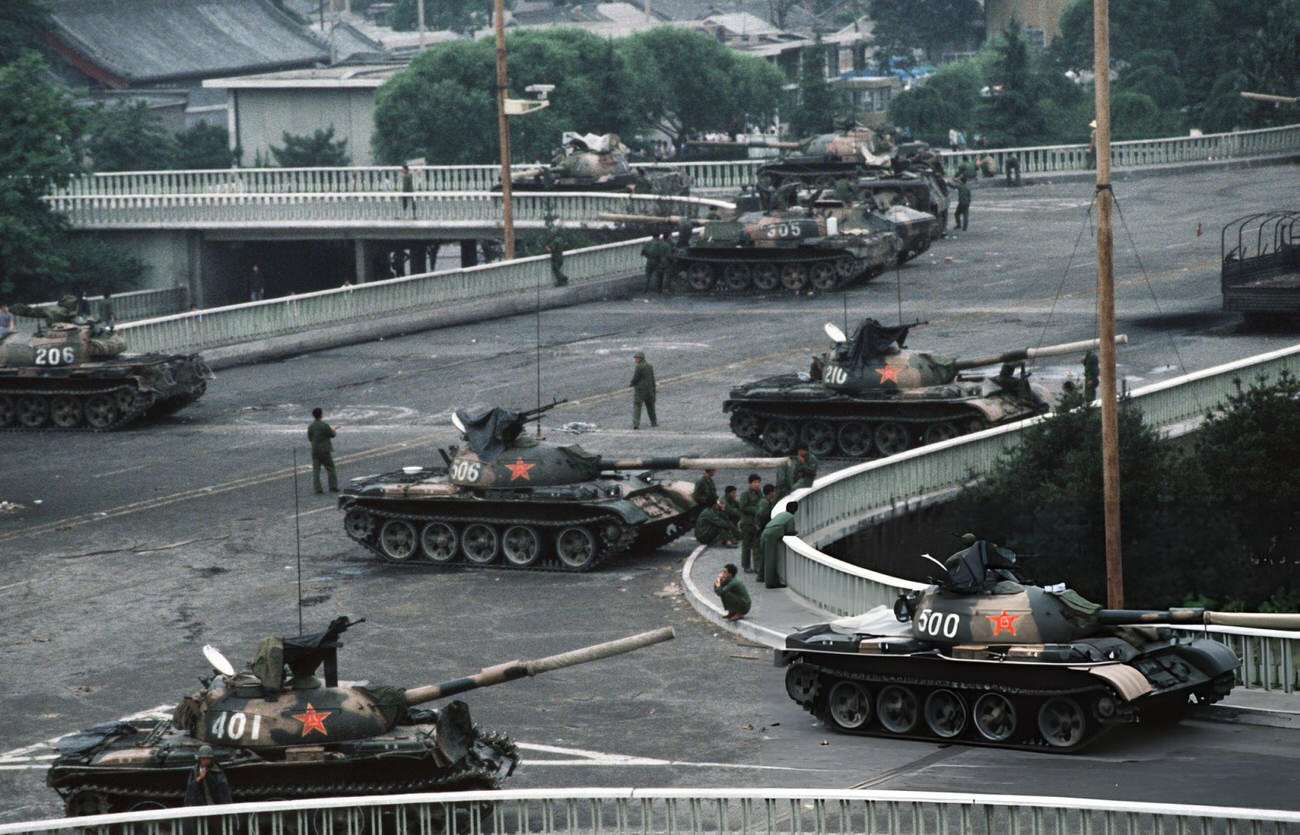
Armored tanks sit across an overpass on Changan Avenue, their long barrels angled over empty lanes and pale guardrails, turning an everyday arterial road into a hard checkpoint. Red star insignia and turret numbers stand out against dark metal, while small groups of soldiers cluster near the vehicles, watching the approaches and the curve of the ramp. The wide, elevated viewpoint emphasizes control of space—machines arranged to deny movement toward Tiananmen Square in 1989.
Details in the scene pull the eye from one blocking position to the next: multiple tanks staggered at intervals, scattered debris on the roadway, and the stark geometry of the overpass slicing through trees and low buildings beyond. No crowds appear here, only the quiet after pressure has been applied, with armed personnel stationed beside tracked vehicles that dominate the urban landscape. It’s a snapshot of military presence in Beijing at a moment when public life and political power collided.
For readers searching the history of the 1989 Tiananmen Square protests, Changan Avenue, and the Chinese Army’s deployment of tanks in the capital, this photograph offers a sobering reference point. The image conveys not just force, but procedure—road control, containment, and the visible transformation of civic infrastructure into a barricade. Seen today, the overpass becomes a symbol of how quickly a city’s familiar routes can be repurposed during crisis and civil unrest.