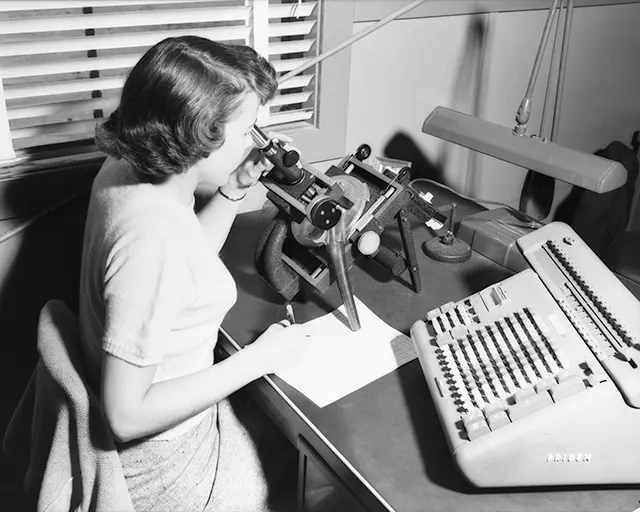
Poised at a tidy desk, a NACA “computer” leans into a microscope while a large mechanical calculator waits within easy reach, turning close observation into columns of numbers. The scene foregrounds the hands-on craft behind mid-century aerospace research: careful measurement, patient checking, and the steady rhythm of calculation long before screens and software made such work feel instantaneous.
Light from the window blinds cuts across the workspace, emphasizing the instruments that defined technical labor in 1954—precision optics, clamps and controls, paper forms, and the unmistakable presence of an adding machine with rows of keys. It’s an intimate view of the era’s engineering pipeline, where data was physically handled, inspected, and computed in an environment designed for accuracy.
NACA, the National Advisory Committee for Aeronautics, relied on human computers to transform experimental readings and microscopic details into reliable results for aerodynamics and flight testing. For readers searching for a historical photo of NACA computers, early computing, or women in STEM, this image offers a grounded reminder that “computation” once meant a person, a desk, and a disciplined partnership with instruments.