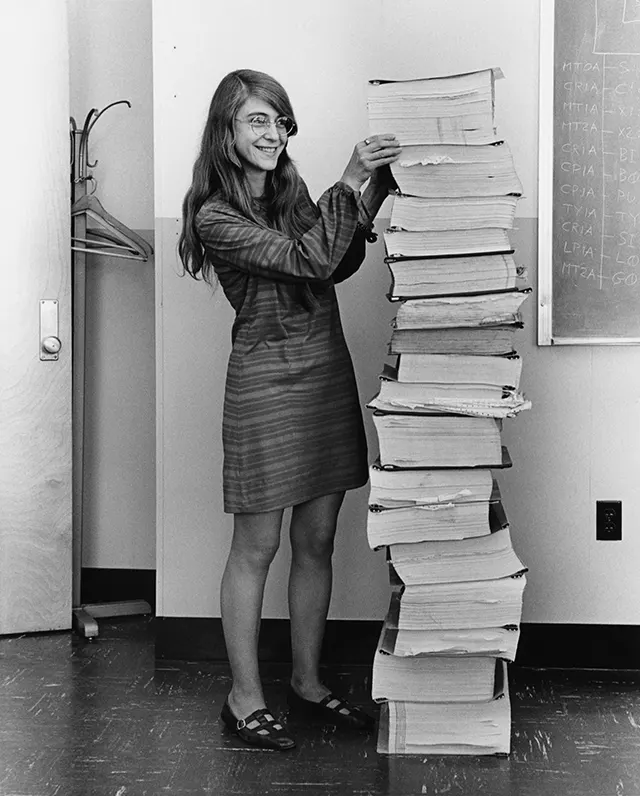
Margaret Hamilton stands with an easy smile beside a towering stack of paper—listings of software produced by her MIT team for NASA’s Apollo project in 1969. The scene is striking in its simplicity: a modest office corner, a chalkboard with technical scribbles, and a column of printouts rising nearly to her shoulder. It’s a reminder that the “space age” was built not only from rockets and metal, but also from meticulous lines of code rendered here as thick, physical volumes.
There’s an almost theatrical contrast between the calm, ordinary workspace and the extraordinary responsibility those pages represent. Each bound section hints at the labor of early software engineering—debugging, revisions, and careful documentation—long before code lived comfortably on screens and in repositories. The photo also captures how computing once looked and felt: heavy with paper, dense with symbols, and inseparable from the human discipline required to make complex systems reliable.
For readers interested in inventions, women in STEM, or the history of computer programming, this image offers an iconic gateway into the behind-the-scenes story of Apollo. Hamilton’s presence beside the stacked listings has become a lasting symbol of the scale of work involved in mission-critical software and the teams that shaped it. Seen today, it underscores how foundational programming was to the moonshot—and how tangible those digital achievements once appeared.