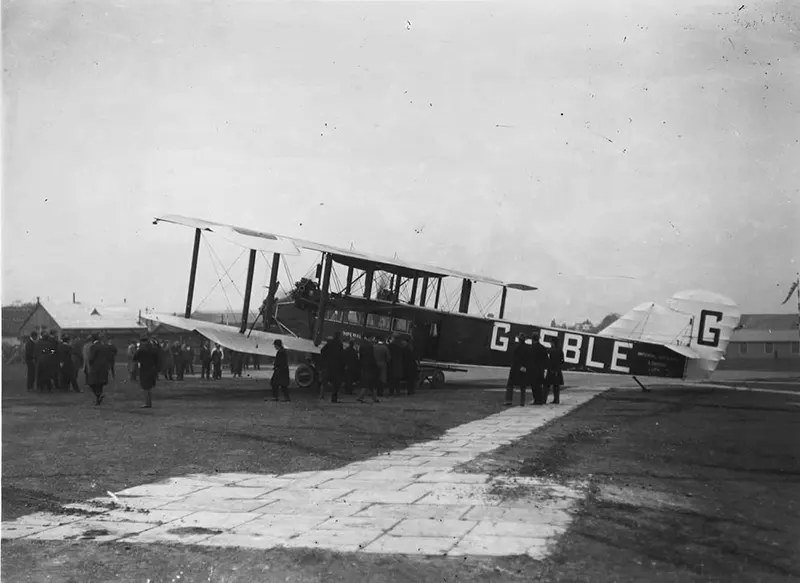
Crowds cluster on an open airfield as a large trimotor biplane rests with its nose slightly angled, the kind of machine that made early commercial aviation feel both daring and practical. The registration “G‑EBLE” stands out on the rear fuselage and tail, while struts, wires, and twin wings form a lattice of early engineering. A paved strip of rectangular slabs leads the eye toward the aircraft, hinting at the improvisational ground infrastructure that predated modern runways and terminals.
Three engines—one mounted on the nose and one on each lower wing—signal a period when designers chased reliability through redundancy, especially for passenger service. The boxy cabin and multiple windows suggest a focus on carrying people or mail rather than chasing speed records, bridging the gap between experimental flying and scheduled routes. Even in a still photograph, the aircraft’s scale against the bundled onlookers conveys how transformative these “inventions” appeared to the public at the time.
Moments like this belong to the formative chapter of airline history, when commercial trimotor biplanes were symbols of confidence in technology and the promise of faster connections between communities. Details such as the visible rigging, stout landing gear, and busy gathering around the fuselage make the scene rich for readers interested in vintage aviation, early passenger aircraft, and the evolution of air transport. For anyone exploring how flight moved from spectacle to service, this image offers a grounded glimpse of that transition—part engineering experiment, part public event.